
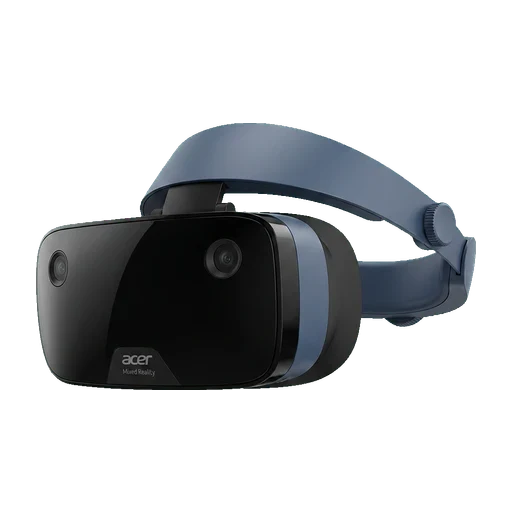
Acer OJO 500 — specification and verdict
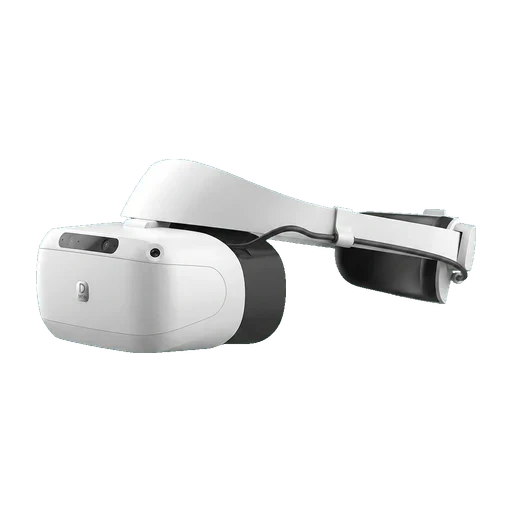
The OJO 500 pairs two 1440x1440 LCD panels running at 90 Hz across a 100-degree field of view, which was competent for reading gauges and labels in 2019 and is merely adequate now. It is a tethered PC headset: HDMI 2.0 and USB 3.0 to a workstation, two on-board cameras for inside-out 6DoF, no eye tracking and no hand tracking. Trainees interact only through the two included first-generation Windows Mixed Reality controllers, which run on AA cells for about 8.5 hours and offer a trackpad, a joystick, face buttons and triggers. The mechanical IPD wheel covers 60 to 69 mm, so it fits a narrower range of faces than most current headsets. At 600 grams with the halo strap it is not heavy, but every session is anchored to a cable and a PC.
There is no fleet management story here: Acer never shipped an MDM agent or a kiosk mode for the OJO 500, so each headset is really an accessory to a Windows PC that somebody else has to manage. Our Android-based training courses do not run on it at all, because it is a PC-tethered device with no on-board compute. What it did solve is hygiene: the display module and the face plates detach, the foam interface comes out, and Acer offered a machine-washable soft strap for shared use. Beyond the 399 USD launch price you are budgeting for a VR-capable workstation per station, plus AA batteries for the controllers, and from 1 November 2026 for a Windows install old enough to still contain the Mixed Reality runtime.
Do not buy one for training in 2026. The Windows Mixed Reality platform it depends on loses support on 1 November 2026 and was already stripped out of Windows 11 in late 2024, which means a fresh PC cannot even set the headset up. If the detachable, cleanable front module is what attracted you, buy a current standalone headset with a swappable facial interface instead and keep the PC out of the loop.
How it compares within its class
The axis runs from the lowest to the highest published figure among the VR — PC-tethered devices in this catalogue. The grey tick is the median of that class.
Median for this class: 110°, from 39 models that publish the figure.
Median for this class: $899, from 45 models that publish the figure.
Controllers and hand tracking
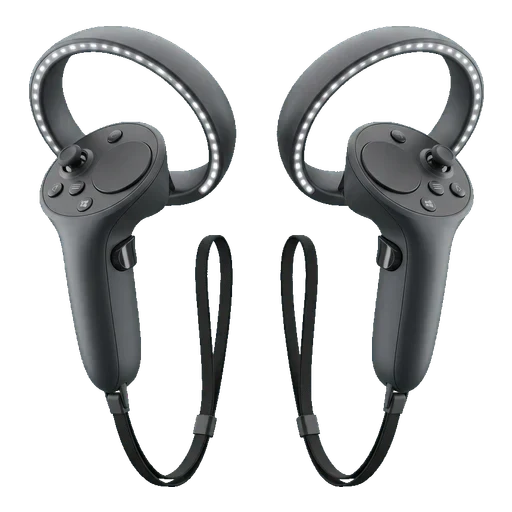
Windows Mixed Reality motion controller (first generation)
6DoF
Microsoft's answer to base stations: the headset's own sensors watch the LED halo, and nothing goes on the walls. Two AA cells each, a touchpad and a thumbstick as separate inputs, and — the honest caveat — once it leaves the headset's view for long enough the system body-locks it to you and estimates where it is.
In the boxHow it is tracked
Headset cameras
The headset watches markers on the controller, so it loses a hand held behind the back or low at the hip until it comes back into view.
The controller itself
- Controller weight
- 173 g
- Controller power
- AA batteries
- Controller haptics
- Yes
- Finger tracking on the controller
- None
- Controller inputs
- trackpad · joystick · face buttons · triggers
Other controllers
Specific controllers from another maker
Windows Mixed Reality motion controllers (Acer, Dell, HP, Lenovo, Samsung, ASUS)
Bare hands
No hand tracking — a controller is the only way in.
Full specification
An em dash means the manufacturer does not publish that figure.
- ManufacturerWho makes it — and who you buy support from.
- Acer
- CategoryWhich kind of product this is. It decides which rows below make sense at all.
- VR — PC-tethered
- Device typeWhere the computing happens, and therefore what you need to run it.
- PC-powered VR
- AnnouncedThe day it was shown, which is not the day it shipped.
- 2018-08-29
- ReleasedYear the model went on sale. Older is not automatically worse in this category.
- 2019
- AvailabilityWhether you can still order it new today.
- Discontinued
- Support endsThe date the manufacturer stops supporting it. Decisive for a fleet you are about to buy.
- 2026-11-01
- PanelThe screen type. micro-OLED gives deeper blacks and higher contrast; LCD is brighter and cheaper.
- LCD
- OpticsThe lenses in front of the panel. Pancake stays sharp closer to the edges than older Fresnel, which decides how much a trainee has to aim their head to read something.
- Optics: not published by the manufacturer
- Eyes coveredOne eye or both. Over a full shift this is a real difference in fatigue.
- Both eyes
- Resolution per eyePixels delivered to each eye. Higher means small text and labels stay readable.
- ≈1440x1440*VRcompare
- Refresh rateImages per second. Higher feels smoother and helps people prone to motion discomfort.
- ≈90 Hz*VRcompare
- Field of viewHow much of your view the image covers. Bigger is more immersive, not automatically better for work.
- 100°
- Pixel densityPixels per degree of view — the honest way to compare sharpness between a headset and a pair of glasses. Higher is sharper. Only shown where somebody published it; we never compute it ourselves.
- Pixel density: not published by the manufacturer
- BrightnessIn a plant or outdoors, brightness decides legibility more than resolution does.
- Brightness: not published by the manufacturer
- WeightThe device alone. Anything above roughly 150 g is felt within an hour.
- Weight: not published by the manufacturer
- Visible field of viewWhat the eye actually sees through the optics, by axis.
- Visible field of view: not published by the manufacturer
- Rendered field of viewWhat the device draws. Never smaller than what you see.
- Rendered field of view: not published by the manufacturer
- Binocular overlapWhere both eyes see the same thing — this is where depth happens.
- Binocular overlap: not published by the manufacturer
- Average pixel densityPixels per degree across the image. More is sharper.
- Average pixel density: not published by the manufacturer
- Peak pixel densityThe sharpest point, usually the centre of the lens.
- Peak pixel density: not published by the manufacturer
- Subpixel layoutHow the coloured dots sit in a pixel. A stripe looks cleaner on text than PenTile.
- RGB stripe · 3 subpixels per pixel
- Foveated renderingWhether detail is dropped outside where you look, to save performance.
- Foveated rendering: not published by the manufacturer
- PassthroughWhat the front cameras give you: colour, grayscale, or nothing.
- Passthrough: not published by the manufacturer
- Passthrough camerasResolution, density and frame rate of that camera feed.
- Passthrough cameras: not published by the manufacturer
- IPD adjustmentMatching lens spacing to the eyes. Motorised is fastest when one headset passes between people.
- Manual
- IPD rangeHow far the lenses travel to match eye spacing. A narrow range excludes part of any group of adults, which matters when one headset is shared.
- 60–69 mm
- Works with glassesWhether people who wear glasses can use it — fits over them, or takes prescription lens inserts.
- Works with glasses: not published by the manufacturer
- Vision correctionHow somebody who wears glasses uses it, and in what dioptre range.
- Vision correction: not published by the manufacturer
- DimensionsWidth, height and depth of the device itself.
- Dimensions: not published by the manufacturer
- Weight with strapWith the strap it ships with — the weight you actually wear.
- ≈600 g*VRcompare
- Head strapSoft band or a rigid one. Decides how the weight sits over an hour.
- Rigid halo strap
- MaterialsShell and facial interface, in the vendor’s words.
- plastic · foam facial interface
- ColoursColours the manufacturer sells it in.
- Blue
- Haptics in the headsetVibration in the headset itself, not in the controllers.
- No
- TrackingWhether content stays put in the room (6DoF), follows head rotation (3DoF) or is simply fixed.
- inside-out 6DoF, 2 cameras
- Base stationsWhether boxes have to be mounted on the walls before it works.
- Not needed
- Tracking camerasHow many cameras it uses to know where it is.
- 2
- Tracking rateHow often position is recalculated. Higher is steadier.
- Tracking rate: not published by the manufacturer
- Depth sensorA dedicated sensor for distance, on top of the cameras.
- No
- Hand trackingWhether bare hands can operate the interface, without a controller or the phone.
- No
- Eye trackingThe headset knows where the trainee is looking. Enables sharper rendering where they look, and attention analytics.
- No
- Face trackingTracks facial expression — for avatars, not for training scenarios.
- No
- Body trackingHow much of the body the device knows about. Estimated legs are not tracked legs.
- None
- Controllers includedWhether motion controllers come in the box, or are bought separately — or the device is hands-only.
- Yes
- Controller modelThe manufacturer's own name for the controller.
- Windows Mixed Reality motion controller (first generation)
- Controller tracking6DoF controllers track position and rotation, so a hand reaches in space; 3DoF only point. “None” means hands only.
- 6DoF
- Controller tracking methodWhat establishes where the controller is. It decides whether the controller keeps working behind your back or down at your hip — “6DoF” on its own does not say.
- Headset cameras
- Other controllersWhether the headset works with controllers other than the ones it ships with.
- Specific controllers from another maker — Windows Mixed Reality motion controllers (Acer, Dell, HP, Lenovo, Samsung, ASUS)
- Finger tracking on the controllerWhether the controller senses individual fingers, and how.
- None
- Controller inputsButtons, sticks and triggers the controller offers.
- trackpad · joystick · face buttons · triggers
- Controller hapticsVibration feedback in the hand.
- Yes
- Controller powerDisposable cells or a built-in rechargeable — a fleet question.
- AA batteries
- Controller weightOne controller, as the vendor weighs it.
- 173 g
- Other input methodsWays in beyond controllers and bare hands.
- Other input methods: not published by the manufacturer
- Runs Skillsive appsOur own statement about whether Skillsive training applications run on it today.
- No
- Suitable for trainingOur judgement on whether it survives real deployment: comfort, hygiene, fleet management.
- No
- Kiosk mode / MDMVendor tooling to enrol devices, push an app and lock the headset to it. Practically required above ten devices.
- No
- Business tierAn official business tier, so devices belong to the company rather than to employees’ personal accounts.
- No
- Swappable facial interfaceRemovable, wipeable face padding. A consumable, and the difference between shared use and complaints.
- Yes
- CertificationsIndustrial certifications stated on the manufacturer's own page. Empty means unconfirmed, never "probably fine".
- Certifications: not published by the manufacturer
- PortsPhysical sockets and charging contacts.
- HDMI 2.0 · USB 3.0 · headphone jack
- Wi-FiThe Wi-Fi generation — it decides how well wireless streaming holds up.
- Wi-Fi: not published by the manufacturer
- BluetoothFor controllers, headphones and accessories.
- Bluetooth: not published by the manufacturer
- Video from a computerWhether a computer can drive it, over a cable or wirelessly.
- Over a cable (HDMI 2.0, USB-C (USB 2.0))
- AudioBuilt-in sound. Matters most where somebody has to hear a remote expert while working.
- Built-in speakers · Headphone jack
- MicrophoneBuilt-in microphone — the other half of talking to a remote expert.
- Yes
- MicrophonesHow many. An array picks a voice out of a noisy hall; one does not.
- Microphones: not published by the manufacturer
- Price bandThe band it sits in, rather than a price that goes stale.
- Mid range
- Launch priceThe manufacturer's launch price. Fixed history, so it never goes stale.
- $399
- Price by configurationWhat each configuration cost at launch.
- Price by configuration: not published by the manufacturer
- Price todayApproximate current net price in USD — a general figure, since these barely differ between regions once tax is stripped out. A snapshot from the date shown, not an offer.
- Price today: not published by the manufacturer
- Comfort (from reviews)How it wears over a full session. Scored from agreement between independent reviewers, not from our own testing.
- Comfort (from reviews): not published by the manufacturer
- Edge clarity (from reviews)Sharpness away from the centre of the lens. Scored from agreement between independent reviewers.
- Edge clarity (from reviews): not published by the manufacturer
- Tracking reliability (from reviews)How tracking holds up in poor light and fast movement. Scored from agreement between independent reviewers.
- Tracking reliability (from reviews): not published by the manufacturer
- Hand tracking quality (from reviews)How usable controller-free hand tracking is in a training scenario. Scored from agreement between reviewers.
- Hand tracking quality (from reviews): not published by the manufacturer
Who this device is for
The OJO 500 was aimed at commercial buyers who rotate one headset through many heads — training rooms, showrooms, design reviews — and who wanted the face plate and display module to come off between users. Acer even offered custom branding on the shell for those customers. Today that audience is exactly the one that cannot afford a headset with a hard platform end date.
What is missing, and what the manufacturer does not publish
Acer's own press release claims a 100-degree field of view while VRcompare measures 95 degrees horizontal and 93 vertical, and the two do not reconcile; we kept Acer's figure and flag the gap. Acer also says the cable carries USB 3.0 where VRcompare records USB-C at USB 2.0 speed. Acer never published a headset-only weight, panel brightness, lens type, or any statement about prescription inserts, and neither party publishes a discontinuation date — the product page on acer.com no longer responds.
Acer OJO 500 in independent reviews
Reviews we consider worth your time, each with a note on what the reviewer actually tested and why it matters for a training rollout. We do not own this hardware, so the tests are theirs — the reading of them is ours.
- VoodooDE VR - english version -2019
A complete review going through display, comfort and lenses in turn, set against the Rift S that was its direct rival. That is the right comparison for a headset from the Windows Mixed Reality generation.
Watch on YouTube - Windows Central2018
Covers the one feature that makes this headset relevant to a training buyer: the detachable design, built so the lens unit can be removed for cleaning and sharing between wearers. That is a hygiene answer almost no headset of its era had.
Watch on YouTube - MRTV - MIXED REALITY TV2018
A short look that lists what Acer added over the standard reference design: manual IPD adjustment, built-in earphones, the retained flip-up display and the detachable lens unit. Those four are the whole argument for this model.
Watch on YouTube
Nothing is sent to YouTube until you press play. Once you do, Google receives your IP address and device data and may process them outside the EEA — see our privacy policy for the details.
Acer OJO 500 — frequently asked questions
- Will the Acer OJO 500 still work after Windows Mixed Reality support ends on 1 November 2026?
- Not on a current PC. Microsoft removed the Windows Mixed Reality runtime from Windows 11 in late 2024, and from 1 November 2026 the software the OJO 500 needs is no longer downloadable at all; commercial support runs one year longer. A headset already paired with an older Windows install that still has the runtime keeps working with SteamVR until that machine is updated, which is a maintenance liability, not a plan.
- Can the Acer OJO 500 display module really be taken off and cleaned between trainees?
- Yes, and it was the headset's main selling point. The display module lifts out of the halo strap, the face plates are removable and swappable, and the foam facial interface comes out for cleaning; Acer also offered a machine-washable soft strap variant. That hygiene design is genuinely good and it is the one reason people still mention the OJO 500 — it just does not compensate for the dead platform underneath.
- Is a second-hand Acer OJO 500 worth it for VR training given it launched at 399 USD?
- No. Whatever a used unit costs, it still needs a VR-capable Windows PC per station, AA batteries for its first-generation controllers, and a Windows version that Microsoft no longer ships. Our training courses are standalone Android applications and will not run on it under any configuration, so the money is better spent on a standalone headset.
Compare this device
Consider these too
The nearest devices in the same class, ranked by availability and launch price — not by our opinion of them.
Specifications checked against the manufacturer's page on 2026-08-08. Manufacturer's specification
Product and company names used here are the trademarks of their respective owners and appear only to identify the hardware being compared. We are not affiliated with, sponsored by or endorsed by any of these manufacturers. Illustrations are our own.