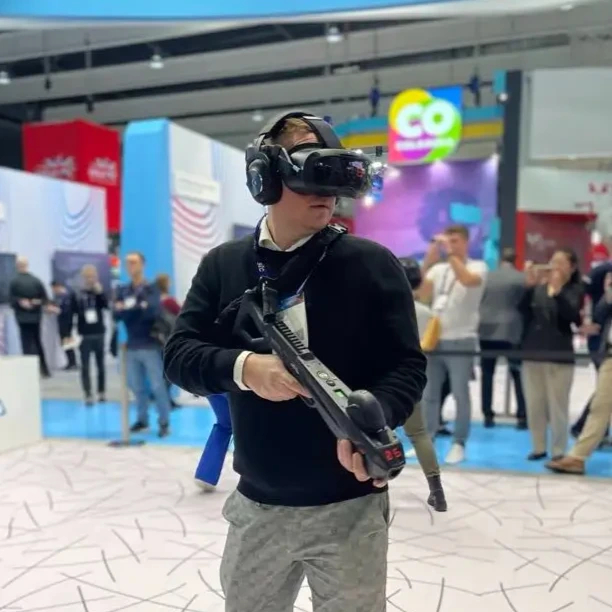
Does OSHA accept VR training? Yes, as one part of a training program, and no, as the whole of it. OSHA's position comes from what it has written about computer-based and online training: interactive, self-paced learning is welcome, provided trainees can put questions to a qualified trainer and the program includes hands-on practice. A VR headset is a form of interactive learning, so the same conditions apply.
That answer covers the general rule. Some standards add details of their own, and three of them matter most for employers looking at VR: forklifts, portable fire extinguishers and hazardous waste operations. They are below, with links to the text of each rule.
What OSHA has said about computer-based training
OSHA's key document is a 1994 letter of interpretation. It says self-paced, interactive computer-based training can serve as a valuable tool "in the context of an overall training program", but that such training by itself would not be sufficient. It must be supplemented by the chance to ask questions of a qualified trainer.
The letter (OSHA, 1994) answered a question about HAZWOPER, yet OSHA has used the same reasoning since. It even suggests how to meet the trainer requirement: a telephone hotline that gives trainees direct access to someone qualified.
A 2019 letter (OSHA, 2019) repeats the point for online training and adds the second condition plainly. Online training without hands-on training would not comply with OSHA's worker training requirements. The ability to ask questions and get answers in good time is, in OSHA's words, critical to effective training.
The three conditions for VR
Put together, the two letters give a working test. VR training holds up with OSHA when it is interactive, when a qualified trainer can be reached during the training, and when it sits next to hands-on practice with the real equipment.
The first condition is where VR is strongest. A trainee does not read about a spill or watch a video of a forklift tipping. They make the decisions, and the scenario responds. The second is organisational: a trainer in the room, on a call or on a hotline while the session runs. The third is the one people try to skip, and it cannot be skipped. VR prepares people for the real equipment. It does not replace the moment they handle it under supervision.
Forklifts: interactive learning is named in the rule
The forklift standard is unusually specific. 29 CFR 1910.178(l)(2)(ii) says operator training "shall consist of a combination of formal instruction (e.g., lecture, discussion, interactive computer learning, video tape, written material), practical training", and an evaluation of the operator's performance in the workplace.
So the rule itself (29 CFR 1910.178, OSHA) puts interactive computer learning in the formal instruction column. A VR forklift scenario belongs there. Practical training and the evaluation remain separate steps, and only people with the knowledge, training and experience to train and evaluate operators may run them.
Two more parts of paragraph (l) are worth knowing. Each operator's performance must be evaluated at least once every three years. Refresher training is due sooner after unsafe operation, an accident or near miss, a poor evaluation, a different type of truck or a changed workplace condition. Then the employer certifies that each operator was trained and evaluated. Our guide on forklift operator training covers the topics in detail.
Fire extinguishers: annual education
Where employers provide portable extinguishers for employees to use, 29 CFR 1910.157(g) requires an educational program on the general principles of extinguisher use and the hazards of incipient stage fire fighting. It must be given on initial employment and at least annually after that.
The text of 29 CFR 1910.157 (OSHA) does not prescribe a teaching method for that education. A VR fire extinguisher scenario lets people practise choosing the right extinguisher and aiming it at a fire that keeps growing while they hesitate, every year if needed.
Employees designated to fight fires under an emergency action plan are a separate group. Paragraph (g)(3) requires training "in the use of the appropriate equipment" on assignment and at least annually. Here the 2019 letter applies: plan for hands-on time with real extinguishers. Evacuation is a separate duty again, covered in our guide on how often fire drills are required.
HAZWOPER: hours are hours
Hazardous waste operations have fixed minimums. Under 29 CFR 1910.120(e)(3)(i), general site workers need at least 40 hours of off-site instruction and at least three days of field experience under a trained, experienced supervisor. Paragraph (e)(8) adds eight hours of refresher training a year.
The minimums are in 29 CFR 1910.120 (OSHA). The 1994 letter was written about exactly this standard, and it rules out one hope. OSHA does not believe computer-based training will, in most cases, let trainees reach competency in substantially less time than the minimum, so the hours stand. VR can fill some of those hours with practice, for example a chemical spill response scenario. It does not shorten them, and the field days still happen in the field.
Training people can understand
OSHA also cares whether workers understood the training, not only whether it took place. A 2010 policy memo says employers must instruct employees in a language and vocabulary they can understand, and tells inspectors to verify that.
The memo (OSHA, 2010) warns compliance officers that training records may exist even when employees could not understand the training. It also notes that handing reading material to employees who cannot read will not meet the obligation.
This is a practical argument for VR. A scenario relies on what people see and do more than on reading, and many come with voice-over in several languages. Check that the language and the vocabulary match your crew, then check understanding in conversation with them. A completed session is a record, not proof that someone understood.
Records
For most standards, OSHA does not dictate a format for training records. The 1994 letter says they may be kept in any form the employer deems appropriate, as long as they are readily accessible to the employer, employees, their representatives and OSHA. HAZWOPER is the exception: workers receive a certificate after initial training.
A VR LMS logs each session with a date, a result and the person's name. That gives you a record you can produce during an inspection and a list of who is due for a refresher. For forklifts, remember that the certification in 1910.178(l)(6) also needs the dates of the practical evaluation and the name of the person who ran it.
A short checklist
- The VR session is part of a written training program, next to hands-on practice with the real equipment.
- A qualified trainer is reachable while people train, in person, on a call or through a hotline.
- Forklift operators still get practical training and an evaluation in the workplace, repeated at least every three years.
- Employees designated to fight fires handle real extinguishers at least once a year.
- HAZWOPER hours and field days are counted in full.
- The language matches your crew, and someone checks that people understood.
- Records show who trained, when, on what, and who evaluated them.
To see which OSHA standards apply to your work and how often they repeat, use our free OSHA training requirements tool, and read what triggers OSHA retraining for the events that bring the date forward. Our page on VR safety training in the USA shows how the scenarios map onto these duties, and the full list is in our VR training catalog. For the research on practice and retention, see why VR training is more effective than traditional training.