
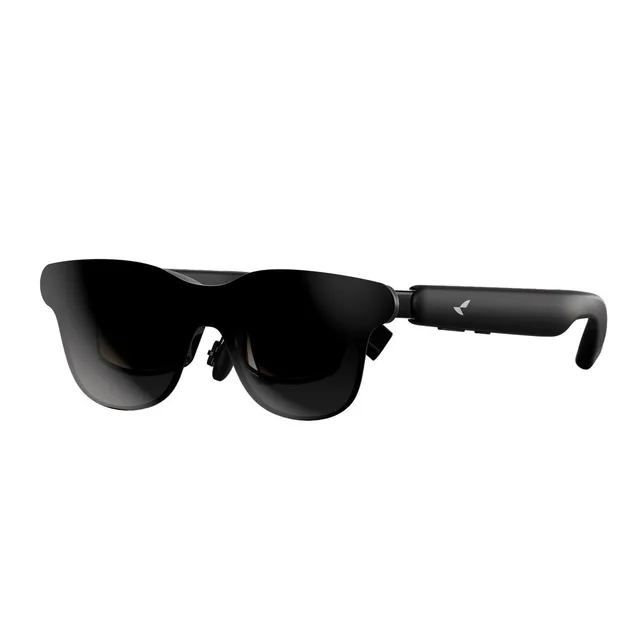
RayNeo GT — specification and verdict
The GT is RayNeo's cheaper cinema viewer: the same 0.6-inch 1920x1080 micro-OLED as the GT Max, spread over 46 degrees for a sharper 49 pixels per degree and a 201-inch default screen (136 or 231 inches selectable), in a 68 g body. Native 3DoF adds Follow, Steady and Pinned modes, the audio is Bang & Olufsen-tuned, and it connects over USB-C. The optic is fixed at 64 mm IPD, so there are no size options as on the GT Max.
A viewer for a phone, tablet, laptop or handheld, not a platform. Everything runs on the connected device: the glasses take video over USB-C and add a display chip, a Zone 360 3DoF chip and speakers, with a companion RayNeo XR App for settings. No SDK, no apps, no device management and no camera. For work its value is a private screen for a laptop on a trip, and nothing beyond that.
The sensible half of the pair for most buyers: lighter at 68 g, sharper at 49 pixels per degree and $100 cheaper in RayNeo's store, with the same panel, 3DoF modes and audio as the GT Max. The costs are a 46-degree field and a fixed 64 mm optic. Pinned mode is dimmer (336 against 1,200 nits), Dolby Vision needs the separate Pocket TV Pro, and there is no full independent review of the GT alone yet.
How it compares within its class
The axis runs from the lowest to the highest published figure among the AR — wearable display devices in this catalogue. The grey tick is the median of that class.
Median for this class: 45 PPD, from 6 models that publish the figure.
Median for this class: 50°, from 25 models that publish the figure.
Median for this class: 77 g, from 28 models that publish the figure.
Median for this class: 700 nits, from 25 models that publish the figure.
Controllers and hand tracking
Ships without controllers, and does not track hands either.
Bare hands
No hand tracking.
Full specification
An em dash means the manufacturer does not publish that figure.
- ManufacturerWho makes it — and who you buy support from.
- RayNeo
- CategoryWhich kind of product this is. It decides which rows below make sense at all.
- AR — wearable display
- Device typeWhere the computing happens, and therefore what you need to run it.
- Phone-powered AR
- AnnouncedThe day it was shown, which is not the day it shipped.
- 2026-08-21
- ReleasedYear the model went on sale. Older is not automatically worse in this category.
- 2026
- AvailabilityWhether you can still order it new today.
- On sale
- Support endsThe date the manufacturer stops supporting it. Decisive for a fleet you are about to buy.
- Support ends: not published by the manufacturer
- DisplayHow the image is produced. "No display" is a real answer in this category, not a gap.
- Birdbath optics
- Eyes coveredOne eye or both. Over a full shift this is a real difference in fatigue.
- Both eyes
- Resolution per eyePixels delivered to each eye. Higher means small text and labels stay readable.
- 1920x1080
- Refresh rateImages per second. Higher feels smoother and helps people prone to motion discomfort.
- 60/120 Hz
- Field of viewHow much of your view the image covers. Bigger is more immersive, not automatically better for work.
- 46°
- Pixel densityPixels per degree of view — the honest way to compare sharpness between a headset and a pair of glasses. Higher is sharper. Only shown where somebody published it; we never compute it ourselves.
- 49 PPD
- BrightnessIn a plant or outdoors, brightness decides legibility more than resolution does.
- 1200 nits
- WeightThe device alone. Anything above roughly 150 g is felt within an hour.
- 68 g
- Visible field of viewWhat the eye actually sees through the optics, by axis.
- Visible field of view: not published by the manufacturer
- Rendered field of viewWhat the device draws. Never smaller than what you see.
- Rendered field of view: not published by the manufacturer
- Binocular overlapWhere both eyes see the same thing — this is where depth happens.
- Binocular overlap: not published by the manufacturer
- Average pixel densityPixels per degree across the image. More is sharper.
- Average pixel density: not published by the manufacturer
- Peak pixel densityThe sharpest point, usually the centre of the lens.
- Peak pixel density: not published by the manufacturer
- Subpixel layoutHow the coloured dots sit in a pixel. A stripe looks cleaner on text than PenTile.
- Subpixel layout: not published by the manufacturer
- Foveated renderingWhether detail is dropped outside where you look, to save performance.
- Foveated rendering: not published by the manufacturer
- Vision correctionHow somebody who wears glasses uses it, and in what dioptre range.
- Official lens inserts · -10 to 0 D
- DimensionsWidth, height and depth of the device itself.
- Dimensions: not published by the manufacturer
- Weight with strapWith the strap it ships with — the weight you actually wear.
- Weight with strap: not published by the manufacturer
- Head strapSoft band or a rigid one. Decides how the weight sits over an hour.
- Glasses frame
- MaterialsShell and facial interface, in the vendor’s words.
- Materials: not published by the manufacturer
- ColoursColours the manufacturer sells it in.
- Colours: not published by the manufacturer
- Haptics in the headsetVibration in the headset itself, not in the controllers.
- Haptics in the headset: not published by the manufacturer
- TrackingWhether content stays put in the room (6DoF), follows head rotation (3DoF) or is simply fixed.
- 3DoF (rotation only)
- Tracking camerasHow many cameras it uses to know where it is.
- Tracking cameras: not published by the manufacturer
- Tracking rateHow often position is recalculated. Higher is steadier.
- Tracking rate: not published by the manufacturer
- Depth sensorA dedicated sensor for distance, on top of the cameras.
- Depth sensor: not published by the manufacturer
- Hand trackingWhether bare hands can operate the interface, without a controller or the phone.
- No
- Face trackingTracks facial expression — for avatars, not for training scenarios.
- Face tracking: not published by the manufacturer
- Body trackingHow much of the body the device knows about. Estimated legs are not tracked legs.
- Body tracking: not published by the manufacturer
- Controllers includedWhether motion controllers come in the box, or are bought separately — or the device is hands-only.
- No
- Controller tracking6DoF controllers track position and rotation, so a hand reaches in space; 3DoF only point. “None” means hands only.
- None (hands only)
- Other controllersWhether the headset works with controllers other than the ones it ships with.
- Other controllers: not published by the manufacturer
- Other input methodsWays in beyond controllers and bare hands.
- Other input methods: not published by the manufacturer
- Where it computesWhether the device computes on its own or depends on a phone, PC or belt-worn puck.
- Driven by a phone
- ProcessorThe processor and memory inside. This is what the performance grade above is derived from.
- Vision 4000 display chip, Zone 360 3DoF chip
- CPUCores and clocks, where the manufacturer publishes them.
- CPU: not published by the manufacturer
- GPUThe graphics part of the chip.
- GPU: not published by the manufacturer
- MemoryRAM on the device. Together with the chipset it sets how complex a scene can be.
- Memory: not published by the manufacturer
- PlatformThe platform an application is built against — and what an MDM has to speak.
- Platform: not published by the manufacturer
- StorageOn-board space for downloaded courses. More matters for an offline library in several languages.
- Storage: not published by the manufacturer
- SD card slotWhether storage can be added with a card.
- SD card slot: not published by the manufacturer
- Third-party appsHow a third party's application reaches the device: an ordinary Android package, a vendor-only SDK, or not at all.
- Closed platform
- Runs Skillsive appsOur own statement about whether Skillsive training applications run on it today.
- No
- Suitable for trainingOur judgement on whether it survives real deployment: comfort, hygiene, fleet management.
- No
- CertificationsIndustrial certifications stated on the manufacturer's own page. Empty means unconfirmed, never "probably fine".
- Certifications: not published by the manufacturer
- PortsPhysical sockets and charging contacts.
- USB Type-C (DisplayPort Alt Mode)
- Wi-FiThe Wi-Fi generation — it decides how well wireless streaming holds up.
- Wi-Fi: not published by the manufacturer
- BluetoothFor controllers, headphones and accessories.
- Bluetooth: not published by the manufacturer
- Video from a computerWhether a computer can drive it, over a cable or wirelessly.
- Over a cable (USB-C DisplayPort Alt Mode)
- AudioBuilt-in sound. Matters most where somebody has to hear a remote expert while working.
- Built-in speakers
- MicrophoneBuilt-in microphone — the other half of talking to a remote expert.
- Microphone: not published by the manufacturer
- MicrophonesHow many. An array picks a voice out of a noisy hall; one does not.
- Microphones: not published by the manufacturer
- CameraA camera is what makes a remote expert call and photo documentation possible.
- No
- Price bandThe band it sits in, rather than a price that goes stale.
- Mid range
- Launch priceThe manufacturer's launch price. Fixed history, so it never goes stale.
- Launch price: not published by the manufacturer
- Price by configurationWhat each configuration cost at launch.
- Price by configuration: not published by the manufacturer
- Price todayApproximate current net price in USD — a general figure, since these barely differ between regions once tax is stripped out. A snapshot from the date shown, not an offer.
- $329
Who this device is for
For someone who mostly watches rather than works, wants a 201-inch screen in a lighter 68 g body, and cares more about text sharpness than the widest possible view. The GT puts the same 1920x1080 panel across 46 degrees, which RayNeo rates at 49 pixels per degree, with built-in 3DoF so the picture can ride steady on a train or sit pinned in the room. The optic is fixed at 64 mm IPD, so anyone far from that is better served by the GT Max. No camera, no apps, no device management.
How it differs from its predecessor
Against the GT Max it is the sharper and lighter choice rather than the bigger one: 46 degrees against 59, 68 g against 78 g and 49 pixels per degree against 38, on the same panel with the same 3DoF modes and audio. Against the RayNeo Air 4 Pro it matches the 201-inch default screen and the 1200-nit headline and adds native 3DoF, with Pinned and Steady beside Follow; RayNeo's comparison lists the Air 4 Pro as Follow only.
What is missing, and what the manufacturer does not publish
The brightness splits the way the GT Max's does: 1,200 nits (called perceived brightness) in the other two modes against 336 nits when the screen is pinned. RayNeo defines the 201-inch default as the view from 6 m. There are no dimensions, no materials beyond a sandblasted finish, no IP rating, no colour list and no field-of-view axis, and the page names the optical engine (Peacock 3.0) but not the lens stack, while RayNeo's press release calls the optics birdbath (BB). RayNeo does not say how far from 64 mm an IPD can drift before the image suffers; it points to the GT Max. The compatibility lists match the GT Max's: iPhone 15 to 17 except the 16e, 17e and Air, Dolby Vision only with the separate Pocket TV Pro, consoles through the HDMI adapter. RayNeo's launch blog quoted $299 and its store now lists $329; RayNeo does not say which is the list price, so the table shows the store price as the current price only. We found no full independent review of the GT alone; the coverage is of the GT Max.
RayNeo GT — frequently asked questions
- Why does the RayNeo GT drop to 336 nits when the screen is pinned?
- RayNeo's spec table lists two brightness figures for the GT, 1,200 nits in the non-pinned modes and 336 nits in Pinned mode, and gives no reason. What it does say is that Pinned keeps the screen fixed in one position, for focused, cinema-like viewing. So the mode that holds the picture still in the room is the dimmest one; check it in daylight before relying on it.
- Will the RayNeo GT fit my eyes with its fixed 64 mm IPD?
- RayNeo builds the GT around a fixed 64 mm interpupillary distance and says to adjust the nose pads and wearing position to centre the image. It publishes no tolerance, and its own advice for anyone who needs a closer match is the GT Max, which comes in S, M and L for IPDs under 64 mm, 64 to 67 mm and over 67 mm. Measure your IPD first: close to 64 mm is what the GT is designed for.
- Is the RayNeo GT sharper than the GT Max?
- On paper, yes. Both use the same 0.6-inch 1920x1080 micro-OLED, but the GT spreads it over 46 degrees, which RayNeo rates at about 49 pixels per degree, while the GT Max spreads it over 59 degrees at about 38. Text and fine detail are denser on the GT, and the picture is bigger and more enveloping on the GT Max. RayNeo's density figures come from its own lab, and no independent measurement is cited.
Compare this device
Consider these too
The nearest devices in the same class, ranked by availability and launch price — not by our opinion of them.
Specifications checked against the manufacturer's page on 2026-10-16. Manufacturer's specification
Product and company names used here are the trademarks of their respective owners and appear only to identify the hardware being compared. We are not affiliated with, sponsored by or endorsed by any of these manufacturers. Illustrations are our own.