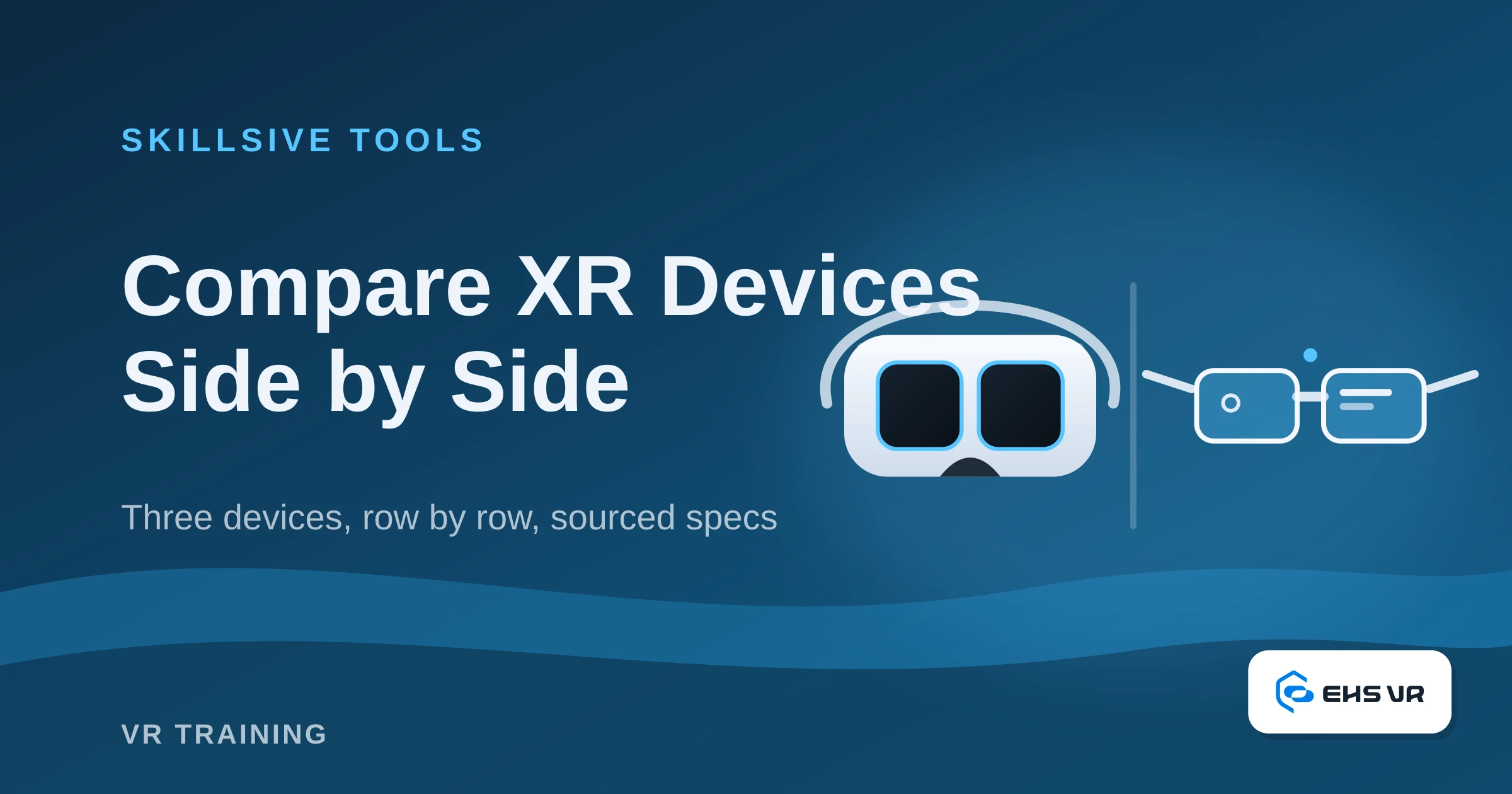
What to compare before buying VR headsets is not what a consumer review compares. Resolution differences look dramatic in a table and rarely decide anything for safety training; four unglamorous rows do. Our free comparison tool puts up to three devices side by side — including a VR headset next to AR glasses — and this article is about which rows to read first.
What "row by row" gets you
Manufacturer pages are marketing surfaces. Each one leads with the specifications it wins on and quietly omits the others, so a side-by-side reading is the only way to see the shape of a device rather than its best angle.
The table computes the differences for you and puts the most decisive first, with a switch to hide every row where the devices agree. On a Quest-versus-Quest comparison that usually collapses most of the table into a handful of rows, which is the actual decision. It also states how many specifications the two share, so "they are basically the same except for X" is a claim you can check rather than a feeling.
Two kinds of missing value
This is the detail that took the most care to get right. When a cell is empty, there are two different reasons, and a single dash for both would mislead.
A dash means the manufacturer does not publish that figure. Apple states no per-eye resolution; HTC and PICO do not publish device weight. That is a fact about the vendor, not about the device.
"Does not apply to this class" means the row is meaningless for that product — battery-in-headset for a PC-tethered device, controller tracking for AI glasses with no controllers. That is a fact about the category.
And where somebody else measured what a manufacturer withheld, the value appears with a ≈ and an asterisk pointing at whoever took the measurement. It is useful information and it should be visible, but it must never read as a vendor claim. Nothing in the table is estimated by us.
Comparing across categories on purpose
Most comparison sites will not let you put a VR headset next to AR glasses, on the grounds that it is not a fair fight. In training procurement it is exactly the comparison people need: the real question is often "do we hand out headsets for scenario practice, or glasses for guidance at the machine?" — and those are different products answering different needs.
So the tool allows it and handles the mismatch honestly, marking rows that exist for one class and not the other. If you are working through that decision, AR vs VR training: which fits what covers the reasoning behind it, and remember that AR does not require glasses at all — a phone or tablet is often the cheaper way to put step-by-step guidance in front of a technician.
Pages for the comparisons people actually search
Popular pairings have their own pages under the tool, because "quest 3 vs xreal one pro" is a phrase people type into a search box, and a query string cannot rank for it. Each of those pages carries the full table, the computed differences and our own verdict on where each device fits, so a comparison is something you can link to in an email rather than a state that lives only in your browser.
For training-specific reading of two popular pairings, we have written them up in full: Quest 3 vs Quest 3S for VR training and Meta Quest vs PICO for business deployments.
What to compare on when the training is the point
Resolution differences look dramatic in a table and rarely decide anything for safety training. Four rows matter more: device management, kiosk mode, swappable facial interfaces and standalone operation. A headset that cannot be locked to one app or updated remotely will cost you more in staff time over a year than the better display gains you in a scenario.
Battery life belongs in that group too, because it sets how many people you can run through a session before a charge break — the arithmetic is in VR headset battery life on a training day.
After the comparison
Once the shortlist is down to one, two questions follow. What will it cost across a year, including the training time it changes — that is the VR training ROI calculator. And what actually runs on it — the VR training catalogue lists the ready-made courses, and our applications are built on open XR standards, so they are not tied to a single manufacturer's SDK.
And a practical note: whichever model wins the table, buy one before you buy twenty. A week of real use answers questions no specification row can, and it is the cheapest test available.