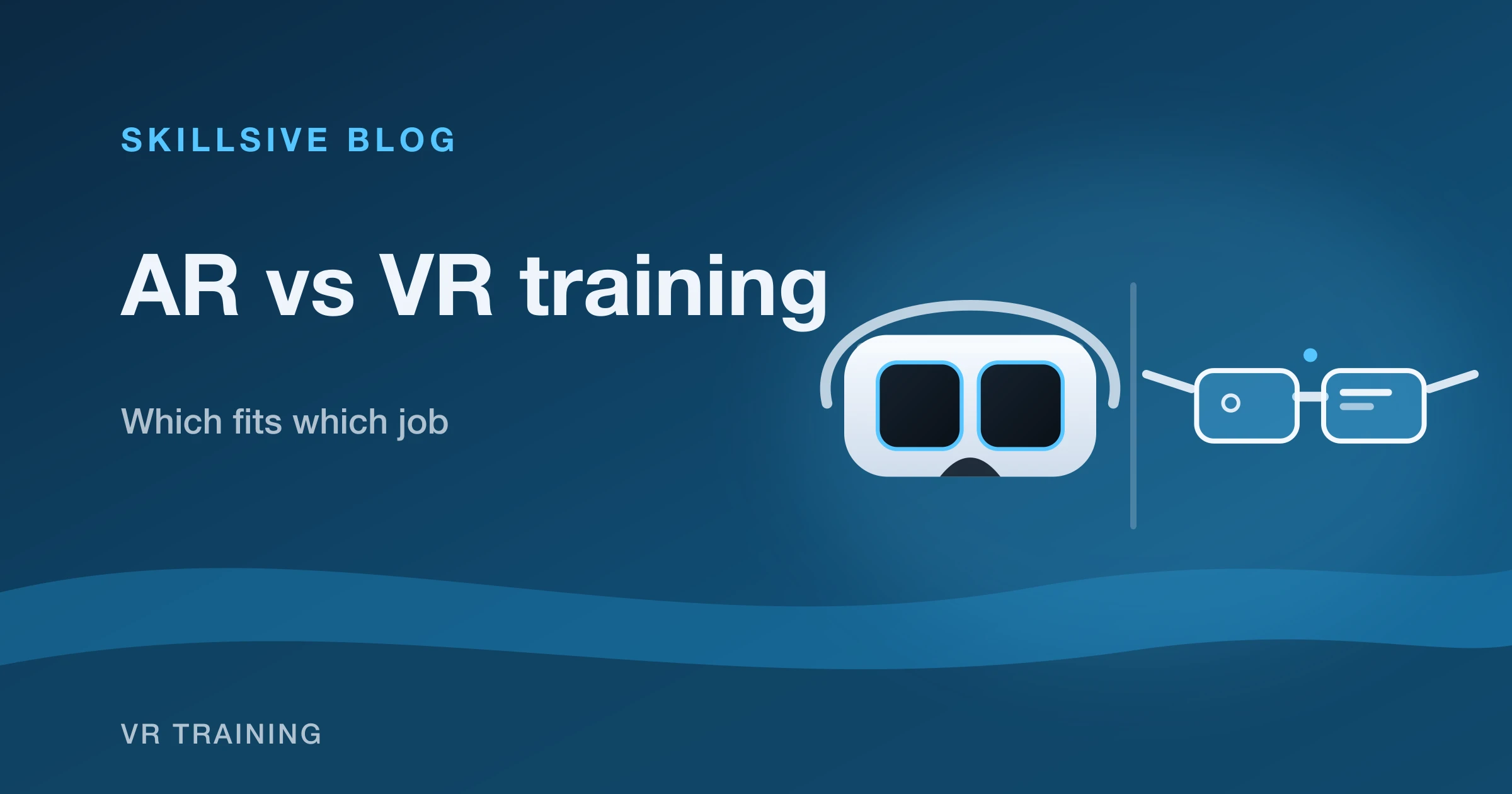
AR vs VR training comes down to one difference: VR replaces the world, AR annotates it. In virtual reality the trainee wears a headset and stands inside a fully simulated scene — a burning warehouse, a rooftop, a machine mid-fault — none of which is really there. In augmented reality the real room stays visible and a digital layer is drawn over it: arrows, labels, instructions floating on the actual equipment in front of the worker.
That single distinction decides which one fits a given job. If the goal is to practise a situation you cannot safely or affordably stage, VR is the tool. If the goal is to guide a real task while someone performs it, AR is the tool. Neither is a better technology in the abstract — they answer different questions, and the useful skill is knowing which question you have. This article maps each to the training it suits, and how to choose.
What AR and VR actually are
VR is immersive and self-contained. The headset blocks the real world and puts the trainee inside a scenario where they can move, look around and act — discharge an extinguisher, follow a lockout sequence, treat a casualty — with no real-world risk. Everything is simulated, which is precisely why VR can stage a fire or a fall that you would never recreate for real.
AR keeps the real world and adds to it. Through a tablet, phone or a pair of rugged smart glasses, the worker sees their actual surroundings with digital information layered on top — the next step highlighted on the machine, a torque value over the bolt, a remote expert drawing on their live view. AR does not remove the trainee from the task; it coaches them through the real one. Enterprise AR hardware from vendors like RealWear and Vuzix is built for exactly this field use, in hard-hat and even explosion-rated form factors.
Where VR wins: dangerous, rare, expensive to stage
VR's home ground is any situation that is too dangerous, too rare or too costly to practise for real. You cannot set a genuine fire under a trainee, flood a confined space, or wait for a real high-angle rescue to happen on training day. VR stages all of it on demand, repeatedly, with no one at risk. That is why the strongest safety evidence sits here: a 2024 meta-analysis of 52 studies found VR outperformed traditional methods on learning and retention, while noting wide variation between studies (Scorgie et al., Safety Science 171, 2024).
VR also holds attention in a way screen training does not, because there is nowhere else to look. PwC's study found VR learners were far more focused and more confident to act than classroom or e-learning peers (PwC, 2022). For hazard response — extinguisher use, evacuation, working at height — that combination of safe staging and full attention is exactly what the training needs. We cover the wider evidence in why VR training is more effective than traditional training.
Where AR wins: guided real-world tasks
AR is strongest when the task is real and the trainee needs help doing it correctly, now. Instead of practising a maintenance procedure in simulation, the technician performs the actual procedure with each step overlaid on the actual machine — which reduces errors and shortens the gap between "trained" and "competent on this specific equipment." For assembly, inspection and field service, that on-the-job guidance is worth more than a separate simulated rehearsal.
The other AR strength is remote expertise. A less experienced worker sees the equipment; a senior expert, anywhere, sees the same live view and annotates it. That turns one specialist into support for many sites without travel. AR does not try to immerse the worker in a fake world — its value is precisely that it keeps them in the real one, hands on the real thing, with a knowledgeable layer added.
Cost, hardware and rollout
The format does not decide the cost — the content and the hardware do. AR frequently runs on devices already in the field: tablets, phones, or rugged glasses a technician wears anyway. VR needs headsets, which is a real line item, though a modest one per device. On the AR side the word covers four very different products — industrial glasses, spatial headsets, wearable displays and camera glasses with no screen at all — and only some of them can run an application; our XR device catalogue keeps them apart device by device. So for a workforce that already carries tablets, AR can start cheaper; for a training room, VR headsets are a clean fit.
Content is the other half. A VR scenario is a built simulation; bespoke AR that must recognise real objects and track them in space can be just as involved to produce. The honest rule is to price each use case on its own, not to assume one letter is cheaper than the other. Where no ready-made course fits a specialised process, custom AR or VR can be built to order — EHS VR develops both (request a demo).
How to choose, task by task
Ask what the training has to produce. If it must let people rehearse a dangerous or infrequent event safely, choose VR — that is its whole reason to exist. If it must guide a real procedure on real equipment, or bring remote expertise to the point of work, choose AR. If the honest answer is "both" — rehearse the emergency in VR, guide the daily task in AR — then run both, because they are not competitors.
Crucially, this is a per-course decision, not a platform one. Delivery, completion records and certificates work the same whether a course is AR or VR, so one platform can host both and report them together. Browse the VR course catalog to see what is ready today, read VR vs e-learning for compliance training for how immersive methods compare with screen-based ones, and use the help center to set delivery up. Pick the format per task, keep the reporting in one place, and neither AR nor VR ends up as a silo.