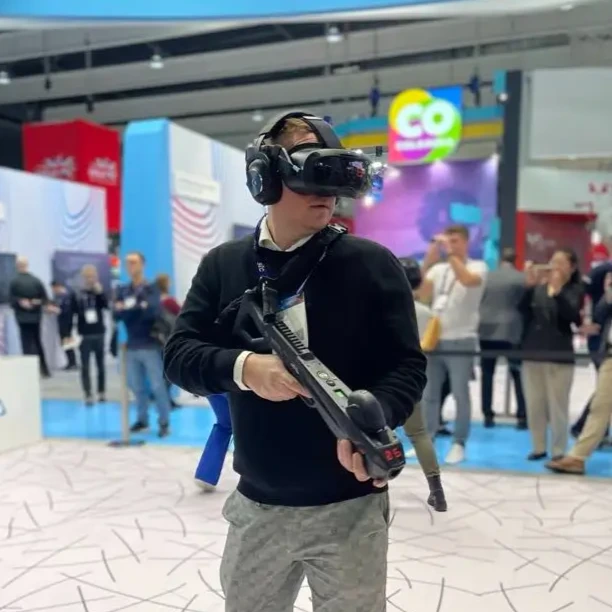
VR vs e-learning is not really a fight over which is "better" — it is a question of what a given compliance course needs to achieve. E-learning is the cheapest way to put knowledge in front of a lot of people and record that they saw it. VR is the better way to make people practise a skill and actually pay attention while doing it. In PwC's study, VR learners were "up to four times more focused during training than their e-learning peers" (PwC, 2022).
For compliance training that split matters, because compliance covers two very different things under one word. Some of it is knowledge — rules, classifications, who to call. Some of it is skill — putting out a fire, isolating a machine, giving first aid. E-learning is well suited to the first. VR is built for the second. This article compares them on the dimensions that decide real outcomes, and gives a way to choose course by course.
What each format is good at
E-learning is screen-based, self-paced digital training: slides, video, interactive checks, a quiz at the end. Its strengths are distribution and cost. You can push a module to a thousand people overnight, update it centrally, and get an automatic completion record. For factual, knowledge-first compliance — data protection basics, chemical classifications, reporting lines — it does the job cheaply.
VR is immersive, hands-on practice. The trainee stands inside a scenario and does the task: discharges the extinguisher, follows the lockout sequence, works the casualty. Its strengths are attention and transfer — the training feels like doing the real thing, so the skill is more likely to hold up when it counts. Its weakness is the opposite of e-learning's strength: it costs more to start and each headset trains one person at a time.
Attention: the quiet advantage
The biggest practical gap between the two is not knowledge, it is focus. E-learning competes with every other tab, notification and phone on the desk, and plenty of people click through a module while barely watching. PwC named this directly: with VR, "there are no interruptions and no options to multitask," and their VR-trained employees were up to four times more focused than e-learning learners and 1.5 times more focused than classroom ones (PwC, 2022).
Focus is not a vanity metric for safety training. A worker who half-watched an e-learning module on confined-space entry has technically "completed" it and learned little. In a headset there is nowhere else to look, which is exactly why the format suits the training you cannot afford people to tune out of.
Confidence and doing
Compliance training is only useful if it changes what someone does under pressure. Here VR's edge over e-learning shows up in two of PwC's findings. Learners trained in VR were up to 275% more confident to act on what they had learned, a 35% improvement over e-learning specifically. And they felt 2.3 times more emotionally connected to the content than e-learners (PwC, 2022).
Two honest caveats. PwC's study trained new managers on inclusive leadership, a soft skill, so read these as evidence about how people learn in each medium, not proof about fire drills. For safety specifically, a separate 2024 meta-analysis of 52 VR studies found VR beat traditional methods on learning and retention, while warning of wide variation between studies (Scorgie et al., Safety Science 171, 2024). Neither source says a screen quiz can teach a physical skill.
Cost and scale
This is e-learning's home turf, at least at first. A module is cheap to build and effectively free to send to one more person. VR carries two upfront costs — headsets, and content that PwC found cost up to 48% more to build than a comparable e-learning course. So for a small audience, e-learning almost always wins on price.
The picture changes with volume. Because VR's cost per learner keeps falling while e-learning's stays flat, PwC's study reached cost parity with e-learning at 1,950 learners, and VR grew cheaper per head beyond that (PwC, 2022). If you train large numbers on the same hazards year after year, the gap narrows or reverses. We walk through that maths in VR training ROI: when headsets pay off.
VR vs e-learning, side by side
| Factor | E-learning | VR |
|---|---|---|
| Best for | Knowledge, rules, refreshers | Hands-on skills, reacting under pressure |
| Attention | Easily interrupted | Up to 4× more focused than e-learning |
| Upfront cost | Low | Higher (headsets + content) |
| Cost at scale | Flat per learner | Falls; parity with e-learn near ~1,950 learners |
| Reach speed | Instant to thousands | One learner per headset at a time |
| Records | Automatic | Automatic |
| Practical skill transfer | Weak | Strong |
Neither column is the loser. They are good at different halves of the compliance job.
How to choose, course by course
Do not pick a single format for everything. Ask what each course must produce. If the outcome is knowing something — a policy, a classification, a reporting chain — e-learning delivers it cheaply and fast. If the outcome is doing something under pressure — extinguisher use, lockout/tagout, first aid — the practice VR gives is worth the higher cost, because that is where e-learning quietly fails.
The strongest programs blend the two: an e-learning module for the theory and the annual paper trail, a VR session for the hands-on part that a slideshow cannot teach. Browse the VR course catalog to see which hazards already have ready-made scenarios, read why VR training is more effective than traditional training for the wider evidence base, and use the help center to connect a headset and track completions alongside your existing e-learning.