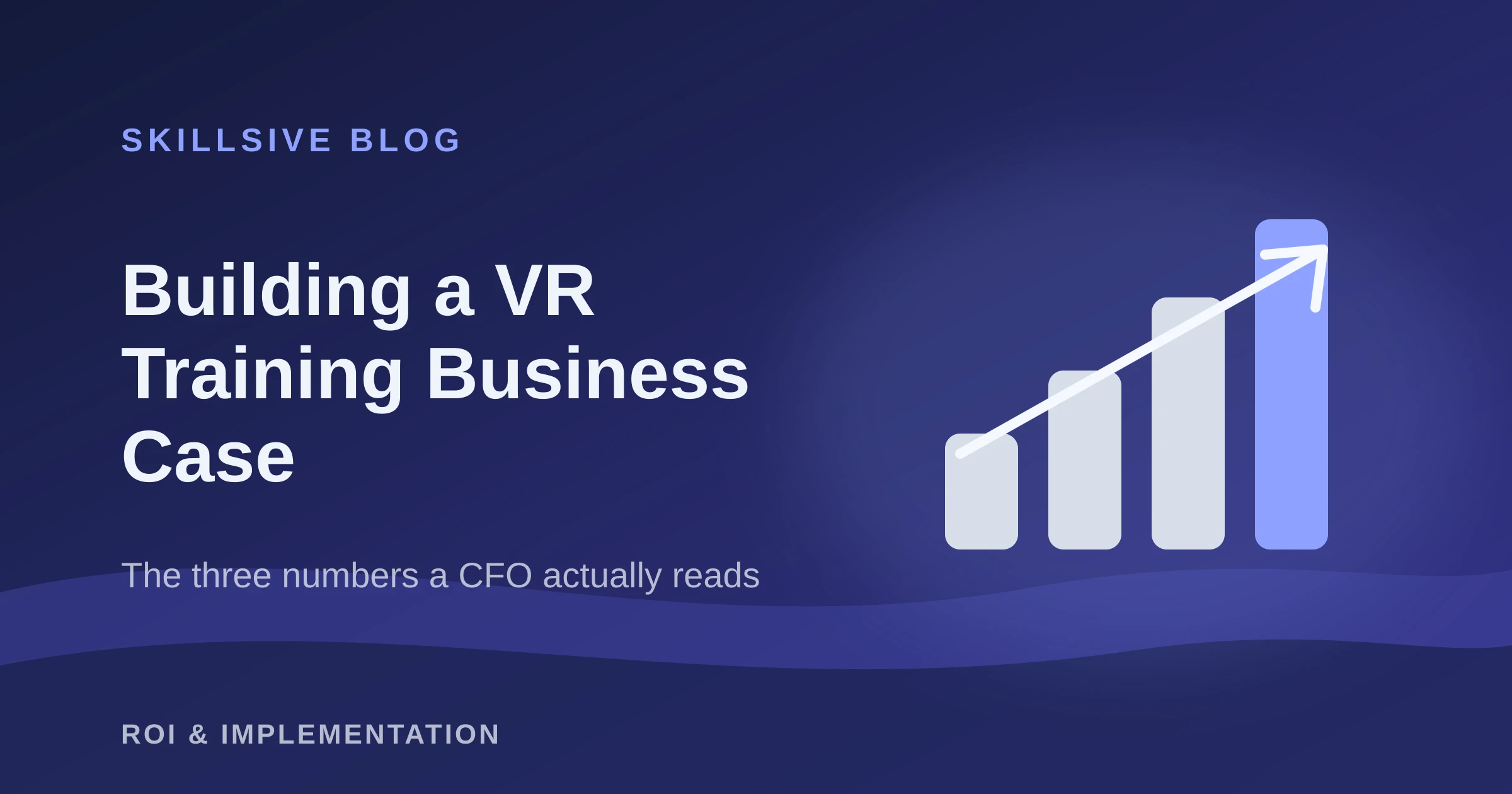
A VR training business case is the one-page argument that gets a CFO to fund headsets instead of another year of classroom sessions, and it stands or falls on three numbers: what training costs today, what VR training would cost instead, and how many months it takes to pay back the difference. Most pitches lose the room by opening with a demo or a vision statement; a CFO reads for those three numbers first and decides whether the rest of the document is worth their time.
What a CFO actually reads
A finance reviewer skims for the baseline cost, the proposed cost, and the payback period, in that order — everything else in the deck is supporting evidence, not the pitch itself. Put those three numbers on page one, in a single sentence if you can, and move the vendor comparisons, screenshots and testimonials to an appendix nobody has to read to say yes.
The baseline: what training costs today
Before you can show savings, you need a real number for the status quo — instructor day rate or salaried trainer time, venue or downtime cost, materials, and the hours each employee spends away from their job, multiplied by how often the session repeats. Most companies have never added this up, which is exactly why the first draft of a business case usually undersells the baseline. PwC's study measured classroom learners taking up to four times longer to complete comparable training than VR learners. Even after accounting for headset setup and instruction time, VR was still three times faster, which is one honest way to size how much of that baseline cost is time, not materials.
What the evidence says VR training saves
The most detailed public figures come from a Forrester Consulting study commissioned by Meta (July 2025), which modeled a composite enterprise customer — $1 billion in annual revenue, 10,000 employees, a third of them training on Meta Quest — and found $6.1 million in three-year benefits against $1.9 million in costs, a net present value of $4.2 million, a 219% ROI, and payback in under six months. Inside that total, travel and on-site training expense dropped by about $1.7 million over three years (roughly a 50% cut), and faster onboarding accounted for another $1.7 million. Treat this as an upper-bound illustration, not your own forecast: Forrester interviewed six decision-makers across only four organizations, and the study was commissioned by the headset vendor whose product it evaluates. It tells you the shape of the case, not your number.
Peer-reviewed research points the same direction on the safety side specifically: a meta-analysis of VR safety training studies found consistent gains in knowledge retention and hazard recognition compared with traditional methods (Safety Science, 2023). Combined with the PwC time-to-competency numbers, that gives you two independent evidence bases — general corporate learning and workplace safety specifically — to cite instead of a single study.
Turning evidence into your payback number
External studies validate that the mechanism works; they don't replace running your own numbers. The cleanest way to get real inputs is a small pilot: one headset, one licensed scenario, a handful of sessions, so you know what a VR training pilot costs in your own building rather than a vendor's estimate. Feed that pilot's per-person time and your classroom baseline into the VR training ROI calculator, and you get a payback period built on your numbers, not a case study from a different industry. For the full model applied end to end, see VR training ROI: when headsets pay off.
Training is usually not optional — frame it that way
In the US, OSHA already mandates training on specific hazards, including hazard communication under 29 CFR 1910.1200 — so for a large share of workplace training, the real decision in front of a CFO is never "train or don't," it's "train this way or that way." That reframing matters in the document: you're not asking for a new expense, you're asking to spend an existing, mandatory training budget more efficiently. Lead with that when the training in question is legally required, and the conversation moves from "why spend this" to "why spend it the expensive way."
Structuring the one-pager
Put the baseline cost, the proposed VR cost and the payback period in the first paragraph, then support each number in its own short section: hardware and content cost (cite real prices, not round estimates), the time or travel saved (cite your pilot or the studies above), and a risk section: what could go wrong and how you'd know early. Show a conservative case next to an ambitious one rather than a single flattering number; reviewers trust a range with visible assumptions more than a headline percentage. Keep the full calculation, vendor quotes and study citations in an appendix; the page a CFO actually reads should fit on a screen without scrolling.
Objections finance will raise
A business case that only shows the payback number invites the harder questions into the room instead of getting ahead of them, so bring short answers with you rather than leaving them for the meeting to raise cold. Shared headsets raise an obvious hygiene question — cover it with our guide to VR headset hygiene for shared training devices instead of promising the concern away with a hand-wave. IT will ask how a headset is locked down outside training hours, what happens if someone tries to install something outside the course, and who manages software once the device count grows past one; VR kiosk mode for training headsets and VR headset fleet management answer exactly that, and referencing them in the appendix signals the plan extends past the pilot into an actual rollout. None of these answers need new research — one line each, with a link for whoever wants the detail — but skipping them is how a solid payback number still gets stuck in a follow-up meeting instead of an approval.
What to leave out
Don't promise a company-wide rollout number before you have pilot data — a single-department pilot is easier to approve and gives you real inputs for the bigger case later. Don't round a saving up "to be safe" in the optimistic direction; round toward the conservative outcome instead, and let the actual result beat your forecast. And don't cite a vendor-commissioned study's headline number as if it were your own finding — attribute it, note who paid for it, and use it to validate your own math rather than substitute for it.
Who this is for
Safety, L&D and operations leaders preparing to ask finance for a VR training budget, and the finance or procurement colleagues who will read that request and want the numbers, not the pitch. Start from the VR course catalog to see what a pilot scenario would actually cost to license, and use the VR training ROI calculator to turn your pilot numbers into the payback figure that belongs on page one.
A VR training business case wins or loses on three numbers, not on how polished the deck looks. Get the baseline right, run a small pilot instead of guessing at the VR side, and hand finance a conservative payback period built on your own figures — that is a document a CFO can actually approve.