How often is safety training required in Spain? Under Ley 31/1995 on the Prevention of Occupational Risks, article 19, every employer must guarantee theoretical and practical training, sufficient and adequate, to each worker. The law sets no fixed number of hours and no universal renewal date. What it does fix are the moments training becomes mandatory: at hiring, when duties change, and when new equipment or technology arrives. Outside those moments, how often training repeats depends on what the job's risk assessment says.
What article 19 actually requires
The law's text, published in the BOE, calls for "formación teórica y práctica, suficiente y adecuada" — theoretical and practical training, sufficient and adequate, in preventive matters. Three words doing real work here: theoretical and practical means a video or a manual alone will not satisfy the duty; sufficient and adequate means the content has to match the actual risk of the job, not a generic company template.
Training also has to be "specifically focused on the job or role" of each worker. A warehouse operator and an office administrator at the same company do not receive the same safety training, even though both must legally receive some.
When it is due, and how often it repeats
The law fixes three clear triggers: hiring (whatever the contract type or its length), a change in duties, and the introduction of new technology or new work equipment. Any one of the three activates the duty, with no exception for company size or sector.
Outside those triggers, the law asks that training "be repeated periodically, if necessary." Necessary is decided by the job's risk assessment, not by a fixed calendar. An office role with stable, low risks may not need annual refreshers; a role involving machinery, chemicals or frequently changing procedures will need training more often. Deciding that cadence is the employer's job, and it is exactly where labour inspections most often find gaps: training given once at hiring and never updated since.
Who pays for the time and the cost
Article 19 settles this without room for interpretation: "su coste no recaerá en ningún caso sobre los trabajadores" — the cost can never fall on workers. The employer may deliver training with its own resources or through an external prevention service, but the bill is always theirs. On time, the law asks for training within working hours whenever possible; if it happens outside working hours, that time is deducted from the worker's day.
What is actually at stake
Spain's National Institute of Safety and Health at Work (INSST) recorded 647,200 workplace accidents with sick leave in 2024, up 2.4% on the previous year (INSST, 2024). Of those, 556,385 (86%) happened during working hours and 90,815 (14%) were commuting accidents. According to training centre Forimte's read of the same report, fatal accidents during working hours reached 573 in 2024, with 655 deaths in total once commuting accidents are included, up 1.6% on 2023 (Forimte, 2024).
That figure does not prove training is failing. It shows the risk is still there even in a country with a thirty-year-old prevention law, and that "we trained people when they were hired" is not a strong defence once the job has changed since.
Where VR training fits, and where it does not
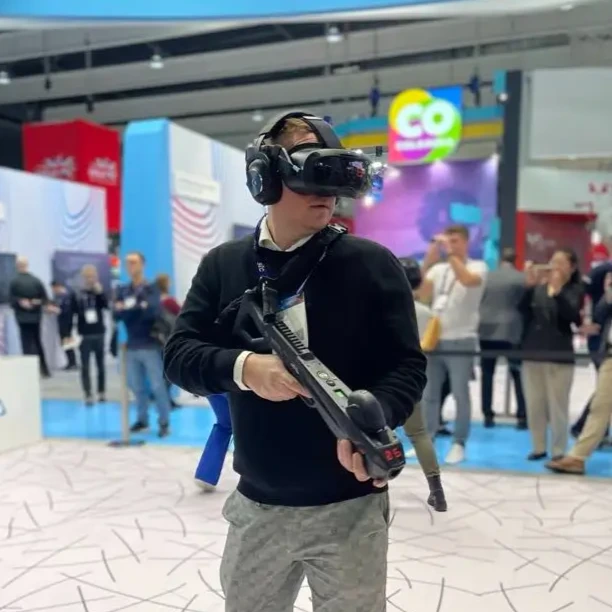
A headset lets a worker rehearse a risk decision as many times as it takes, with a real consequence inside the simulation and none of the physical risk of getting it wrong for real. Our workplace hazard spotting scenario trains people to recognise hazards on the floor before they become an incident, and our safe lifting and manual handling scenario covers one of the most common safety-training topics in warehouses and manufacturing. Every session is logged: who completed it, when, and with what result, exactly what an inspector wants to see.
Neither replaces the theoretical training article 19 requires, nor the hands-on practice on the actual equipment of the job. VR adds the repetition a classroom cannot give, and a record of it; it does not certify anything on its own. Our Spanish-language page on VR safety training in Spain walks through exactly how it fits this law, including QR-verifiable certificates that complement, rather than replace, whatever documentation your prevention service already keeps.
Outside Spain: the same principle in Colombia
The duty is not unique to Spain. In Colombia, Decreto 1072 de 2015, article 2.2.4.6.11, requires the employer to define occupational safety and health training needs and to make sure workers receive sufficient training in that area (HSE Software, on Decreto 1072). The legal text differs, the underlying principle does not: training is not a one-time welcome step, it is a duty that runs for as long as the job does.
Building a programme that survives an inspection
Three pieces cover what the law asks for. Initial training at hiring, specific to the job rather than a generic company talk. Repeat training tied to the risk assessment, dated and signed, rather than to a calendar nobody actually checks. And real practice, either on the job or in VR for scenarios too costly or dangerous to stage live, complementing rather than replacing the hands-on evaluation on the real equipment.
Browse our full VR training catalog to see what is available, and read why VR training is more effective than traditional training for the evidence behind why repeated VR practice sticks better than a single classroom session.