Arc flash training teaches workers to recognize the risk of a sudden, explosive release of energy from an electrical fault, and to isolate or protect against it before working on or near energized equipment. In the US, no single rule uses the words "arc flash training" — the legal floor comes from OSHA's 29 CFR 1910.332, and the detail on risk assessment, PPE and retraining comes from the industry consensus standard NFPA 70E, which OSHA enforces indirectly through the General Duty Clause.
That split trips up a lot of safety programs: employers read 1910.332, see nothing about arc flash, and assume they are covered. They are not. This article covers what each standard actually requires, what an arc flash costs when training fails, and what Poland and Germany require in place of NFPA 70E's specific framework.
What OSHA 1910.332 requires
OSHA's electrical safety training standard applies to any employee who "faces a risk of electric shock" not already reduced to a safe level by the installation requirements in §§ 1910.303–1910.308 (OSHA, 1910.332). Table S-4 in the standard lists the occupations presumed to face that risk (electricians, welders, mechanics, engineers), but anyone doing comparable work qualifies too.
The standard splits training by role. Unqualified employees need enough training to recognize electrical hazards and keep their distance. Qualified employees need to be able to distinguish live parts from de-energized ones, determine the nominal voltage of exposed live parts, and know the clearance distances required at that voltage. Training can be classroom or on-the-job, and OSHA sets no retraining interval — a gap the standard leaves entirely open.
What NFPA 70E adds
NFPA 70E fills that gap and goes considerably further. It requires an arc flash risk assessment before energized work, incident-energy-based PPE categories rather than a single generic outfit, and an energized electrical work permit when de-energizing isn't feasible. OSHA does not adopt NFPA 70E as law, but it cites employers under the General Duty Clause (Section 5(a)(1) of the OSH Act) for ignoring widely accepted practice the standard documents (e-Hazard, 2026). In practice, running 1910.332 training alone and skipping NFPA 70E's risk assessment still leaves the exposure in place.
On retraining, NFPA 70E 110.6(A)(3)–(4) is explicit: "Additional training and retraining in safety-related work practices and applicable changes in this standard shall be performed at intervals not to exceed 3 years" (NFPA 70E, quoted in Electrical License Renewal). Retraining also has to happen sooner if an inspection finds a worker not following procedure, new equipment or technology changes the hazard, a task performed less than once a year needs review, or the person's job duties change.
Why the gap matters
An electrical arc can reach roughly 35,000°F at the arc terminals (about four times the surface temperature of the sun), hot enough to cause second- or third-degree burns instantly at a distance of several feet (Ralph Lee, IEEE Transactions on Industry Applications, 1982). Burn center studies from three separate US hospitals attribute 34% to 55% of work-related electrical burn admissions specifically to arc flash rather than direct shock (Reliamag, compiling Brandt et al. 2002, Arnoldo et al. 2004, Singerman et al. 2008).
The people hurt aren't only electricians. Across 2011–2024, OSHA's own injury reporting recorded 2,070 workplace fatalities from contact with electricity out of 70,276 total occupational fatalities, and 70% of those electrical deaths happened in non-electrical occupations (Electrical Safety Foundation International, 2026). That is the strongest argument for training beyond the "qualified" electrician: most people who die from electrical contact at work were never the ones licensed to touch the panel — they were nearby.
What Poland requires
Poland has no NFPA 70E-style arc flash standard. The legal floor is a licensing model: Article 54 of Prawo energetyczne requires anyone operating electrical networks, devices or installations to hold a świadectwo kwalifikacyjne (qualification certificate) issued by a state examination board, and that certificate "traci ważność po upływie 5 lat" — loses validity after 5 years, at which point the exam has to be retaken (Prawo energetyczne, Art. 54).
On top of the licence, the 2019 Rozporządzenie Ministra Energii w sprawie bezpieczeństwa i higieny pracy przy urządzeniach energetycznych requires employers to name authorized persons in writing (including trainees doing auxiliary work), write a detailed operating instruction for each device covering hazard identification and required protective measures, and keep electro-insulating PPE inventoried and periodically tested per the manufacturer's documentation (summary via SQD Alliance, 2026). It is a procedure-and-licence model, not an incident-energy PPE table — closer to what OSHA 1910.332 covers than to NFPA 70E.
What Germany requires
Germany routes electrical safety through DGUV Vorschrift 3, "Elektrische Anlagen und Betriebsmittel." It requires periodic inspection of every electrical installation and piece of equipment (stationary systems every 4 years, portable equipment on a shorter cycle depending on where it's used), carried out by an Elektrofachkraft (qualified electrician) or, for portable equipment with the right test gear, an electrotechnically instructed person (DGUV Vorschrift 3, §5). That inspection duty sits alongside the general instruction obligation every German employer carries under the Arbeitsschutzgesetz (ArbSchG § 12), which requires re-briefing whenever the task or equipment changes — the same trigger NFPA 70E uses for early retraining, arrived at from a different legal direction.
Why VR fits this training gap
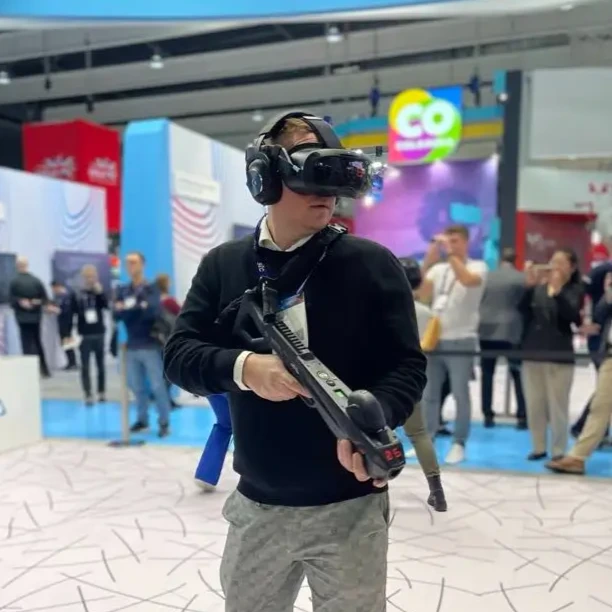
The training moment that actually prevents an arc flash injury isn't memorizing PPE categories from a table — it's a worker, standing in front of an unfamiliar panel, correctly recognizing that it's still energized and choosing to isolate it before opening the door. That recognition-and-decision step is exactly what repeated, consequence-bearing practice builds faster than a one-time lecture (Scorgie et al., Safety Science 171, 2024). Our Lockout Tagout (LOTO) scenario puts that exact judgment call in the trainee's hands: identify every energy source, isolate it in the right order, verify a zero-energy state, before they ever face a live panel. Our Workplace Hazard Spotting scenario trains the broader habit of recognizing an energized-equipment hazard in the first place, which matters most for the non-electricians the ESFI data shows are most often hurt.
Neither scenario replaces the physical fit test for arc-rated PPE or supervised live-work practice — those still belong on the real equipment, with a qualified trainer present. VR closes the gap in between: the decision to isolate, made correctly, before anyone puts on a glove.
Building a program that survives an inspection
Whichever jurisdiction you operate in, the paperwork an inspector checks looks similar: proof of current qualification (świadectwo kwalifikacyjne, an NFPA 70E-compliant training record, or a DGUV-documented Unterweisung), a written procedure specific to the equipment, and a retraining trigger tied to job changes, equipment changes, or a compliance gap an inspection or near miss revealed — not a blanket annual date on the calendar.
If an incident does happen, the workplace accident cost calculator records the absence, investigation time, downtime and other known employer costs without applying a generic multiplier, and the workplace accident statistics tool shows how one incident fits the wider trend. For the Polish periodic BHP training cycle that sits alongside any electrical qualification, check the required safety training tool for the job group in question.
Browse the VR course catalog to match scenarios to the equipment on your site, see why VR training is more effective than traditional training for the wider evidence behind the approach, and use the help center to get a headset connected and completions tracked.