
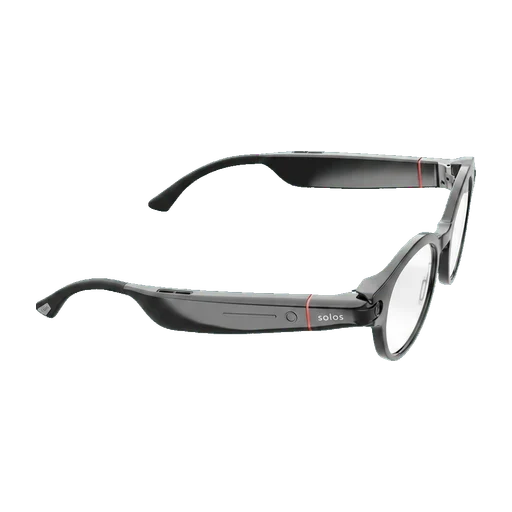
Solos AirGo V2 — specification and verdict
AirGo V2 is a generation rather than a single product: it is sold as the Prime 1 and Prime 2 frames, both at the same price, both with a 16-megapixel camera that records 2K video. Solos files it under “Vision”, which in its vocabulary means a camera rather than a display — there is no screen of any kind, and the eighteen-row specification table has no display, resolution or brightness row at all. It is the only Solos model that records video, it carries an IP54 splash rating, and Solos quotes sixteen hours of photo and assistant use. What it does not publish is the weight: that row on Solos’ own table is an empty dash, while the cheaper audio-only AirGo A5 next to it says thirty-six grams.
Screenless AI glasses are a narrower proposition than they look: with no display, everything the wearer receives is audio, which suits hands-free capture and voice queries and rules out anything that needs to be shown. Solos names two verticals itself — low-vision accessibility through its Envision partnership, and enterprise workflows with Deutsche Telekom — but publishes no fleet management, no provisioning and no volume licensing to go with them. The SDK is real but paywalled at 1,999 dollars, and its licence forbids publishing test results without written consent, which is worth knowing before anyone plans a comparative pilot.
A camera and an assistant on your face for 299 dollars, with an IP54 rating and a sixteen-hour figure that beats most of this class. Two things to weigh. Solos will not publish the weight — the row exists on its own table and is left as a dash, while the cheaper A5 beside it says thirty-six grams — and you cannot attach your own ChatGPT account, so the running cost and the usage caps are whatever Solos decides they are. Also note that “AirGo V2” buys you either a Prime 1 or a Prime 2 frame; they differ in shape and size, not in electronics.
How it compares within its class
The axis runs from the lowest to the highest published figure among the AI glasses devices in this catalogue. The grey tick is the median of that class.
Median for this class: 540 min, from 14 models that publish the figure.
Median for this class: $449, from 19 models that publish the figure.
Controllers and hand tracking
Operated by Voice · Touchpad on the temple.
Bare hands
No hand tracking.
Full specification
An em dash means the manufacturer does not publish that figure.
- ManufacturerWho makes it — and who you buy support from.
- Solos
- CategoryWhich kind of product this is. It decides which rows below make sense at all.
- AI glasses
- Device typeWhere the computing happens, and therefore what you need to run it.
- Phone-powered AR
- AnnouncedThe day it was shown, which is not the day it shipped.
- 2026-01-06
- ReleasedYear the model went on sale. Older is not automatically worse in this category.
- 2026
- AvailabilityWhether you can still order it new today.
- On sale
- Support endsThe date the manufacturer stops supporting it. Decisive for a fleet you are about to buy.
- Support ends: not published by the manufacturer
- DisplayHow the image is produced. "No display" is a real answer in this category, not a gap.
- No display
- Resolution per eyePixels delivered to each eye. Higher means small text and labels stay readable.
- Resolution per eye: not published by the manufacturer
- Refresh rateImages per second. Higher feels smoother and helps people prone to motion discomfort.
- Refresh rate: not published by the manufacturer
- Pixel densityPixels per degree of view — the honest way to compare sharpness between a headset and a pair of glasses. Higher is sharper. Only shown where somebody published it; we never compute it ourselves.
- Pixel density: not published by the manufacturer
- WeightThe device alone. Anything above roughly 150 g is felt within an hour.
- Weight: not published by the manufacturer
- Vision correctionHow somebody who wears glasses uses it, and in what dioptre range.
- Vision correction: not published by the manufacturer
- DimensionsWidth, height and depth of the device itself.
- Dimensions: not published by the manufacturer
- Weight with strapWith the strap it ships with — the weight you actually wear.
- Weight with strap: not published by the manufacturer
- Head strapSoft band or a rigid one. Decides how the weight sits over an hour.
- Glasses frame
- MaterialsShell and facial interface, in the vendor’s words.
- TR90
- ColoursColours the manufacturer sells it in.
- Colours: not published by the manufacturer
- Haptics in the headsetVibration in the headset itself, not in the controllers.
- Haptics in the headset: not published by the manufacturer
- Tracking camerasHow many cameras it uses to know where it is.
- Tracking cameras: not published by the manufacturer
- Tracking rateHow often position is recalculated. Higher is steadier.
- Tracking rate: not published by the manufacturer
- Depth sensorA dedicated sensor for distance, on top of the cameras.
- Depth sensor: not published by the manufacturer
- Hand trackingWhether bare hands can operate the interface, without a controller or the phone.
- No
- Face trackingTracks facial expression — for avatars, not for training scenarios.
- Face tracking: not published by the manufacturer
- Body trackingHow much of the body the device knows about. Estimated legs are not tracked legs.
- Body tracking: not published by the manufacturer
- Controllers includedWhether motion controllers come in the box, or are bought separately — or the device is hands-only.
- No
- Controller tracking6DoF controllers track position and rotation, so a hand reaches in space; 3DoF only point. “None” means hands only.
- None (hands only)
- Other controllersWhether the headset works with controllers other than the ones it ships with.
- Other controllers: not published by the manufacturer
- Other input methodsWays in beyond controllers and bare hands.
- Voice · Touchpad on the temple
- Where it computesWhether the device computes on its own or depends on a phone, PC or belt-worn puck.
- Driven by a phone
- ProcessorThe processor and memory inside. This is what the performance grade above is derived from.
- Processor: not published by the manufacturer
- CPUCores and clocks, where the manufacturer publishes them.
- CPU: not published by the manufacturer
- GPUThe graphics part of the chip.
- GPU: not published by the manufacturer
- MemoryRAM on the device. Together with the chipset it sets how complex a scene can be.
- Memory: not published by the manufacturer
- PlatformThe platform an application is built against — and what an MDM has to speak.
- Platform: not published by the manufacturer
- StorageOn-board space for downloaded courses. More matters for an offline library in several languages.
- Storage: not published by the manufacturer
- SD card slotWhether storage can be added with a card.
- SD card slot: not published by the manufacturer
- BatteryRuntime as the manufacturer states it. A hot-swappable pack matters more than the figure.
- 960 min
- Battery capacity (Wh)Energy in the cell. Bigger is longer, given the same power draw.
- Battery capacity (Wh): not published by the manufacturer
- Battery capacity (mAh)The same fact in the other unit vendors use. We never convert between the two.
- Battery capacity (mAh): not published by the manufacturer
- Charge timeFrom empty to full. Rarely stated by the manufacturer, so it usually comes from whoever timed it.
- 90 min
- ChargerPower of the supplied charger — it decides the charge time above.
- Charger: not published by the manufacturer
- External batteryBattery on a cable or a puck instead of on the head.
- External battery: not published by the manufacturer
- Charging caseExtra runtime carried in the case the glasses ship with.
- Charging case: not published by the manufacturer
- Hot-swap batteryWhether a charged battery can replace the empty one without ending the session. This is what decides if a headset can hold an all-day training station.
- Hot-swap battery: not published by the manufacturer
- Third-party appsHow a third party's application reaches the device: an ordinary Android package, a vendor-only SDK, or not at all.
- App lives on the phone
- Runs Skillsive appsOur own statement about whether Skillsive training applications run on it today.
- No
- Suitable for trainingOur judgement on whether it survives real deployment: comfort, hygiene, fleet management.
- No
- Kiosk mode / MDMVendor tooling to enrol devices, push an app and lock the headset to it. Practically required above ten devices.
- No
- Business tierAn official business tier, so devices belong to the company rather than to employees’ personal accounts.
- No
- CertificationsIndustrial certifications stated on the manufacturer's own page. Empty means unconfirmed, never "probably fine".
- IP54
- PortsPhysical sockets and charging contacts.
- Ports: not published by the manufacturer
- Wi-FiThe Wi-Fi generation — it decides how well wireless streaming holds up.
- Wi-Fi: not published by the manufacturer
- BluetoothFor controllers, headphones and accessories.
- 5.2
- Video from a computerWhether a computer can drive it, over a cable or wirelessly.
- Video from a computer: not published by the manufacturer
- AudioBuilt-in sound. Matters most where somebody has to hear a remote expert while working.
- Built-in speakers
- MicrophoneBuilt-in microphone — the other half of talking to a remote expert.
- Yes
- MicrophonesHow many. An array picks a voice out of a noisy hall; one does not.
- Microphones: not published by the manufacturer
- CameraA camera is what makes a remote expert call and photo documentation possible.
- Yes
- Price bandThe band it sits in, rather than a price that goes stale.
- Mid range
- Launch priceThe manufacturer's launch price. Fixed history, so it never goes stale.
- $299
- Price by configurationWhat each configuration cost at launch.
- Price by configuration: not published by the manufacturer
- Price todayApproximate current net price in USD — a general figure, since these barely differ between regions once tax is stripped out. A snapshot from the date shown, not an offer.
- $299
Who this device is for
For people who want capture and a voice assistant without a screen on their face, and for two verticals Solos names itself: low-vision accessibility through its Envision partnership, and business workflows with Deutsche Telekom. The 16-megapixel camera that records 2K video is what separates it from the rest of the Solos range, and everything the wearer gets back is audio, because there is no display of any kind.
How it differs from its predecessor
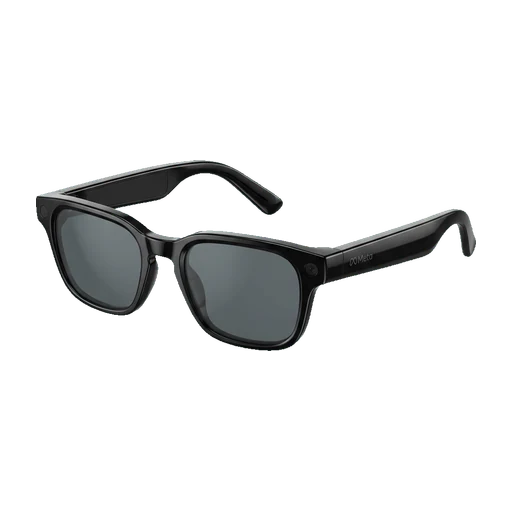
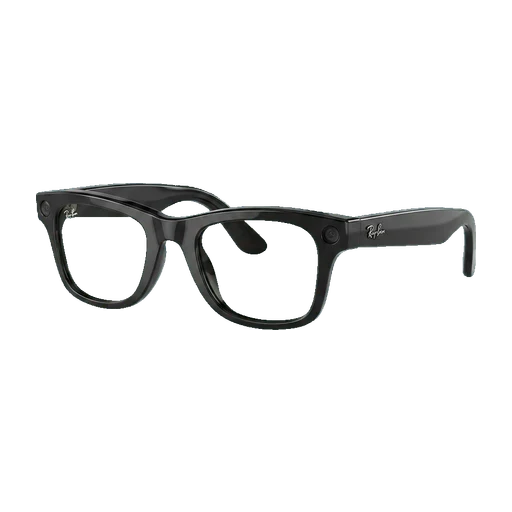
Within Solos’ own line it is the only model that records video: the AirGo V takes photos but cannot film, and the AirGo A5 and AirGo 3 have no camera at all. Against the Ray-Ban Meta Gen 2, the obvious comparison, it is a smaller ecosystem with an IP54 rating and a longer quoted runtime, but Solos publishes no weight where Meta does. Against Brilliant Labs Halo it is the closed, finished-product answer to the same question — no SDK you can afford, but nothing to build either.
What is missing, and what the manufacturer does not publish
The weight is the conspicuous one: the row exists on Solos’ own specification table and is left as a dash, while the cheaper audio-only A5 beside it publishes about thirty-six grams. No battery capacity is given in any unit, only runtimes. No chipset, RAM, storage or operating system is named, so with a 16-megapixel camera and 2K video there is no way to tell how much footage the glasses hold. Only IP54 is published — no CE or FCC marking. The SDK costs 1,999 dollars and its licence forbids publishing test results without written consent. And a personal ChatGPT account cannot be attached, so the running cost and the usage limits are undocumented.
Solos AirGo V2 in independent reviews
Reviews we consider worth your time, each with a note on what the reviewer actually tested and why it matters for a training rollout. We do not own this hardware, so the tests are theirs — the reading of them is ours.
- River Price2026
The fullest of the reviews here, and the one to start with. Independent coverage from River Price, covering live translation and walking directions from glasses with no display at all. Worth the time if that is the part of the device your decision turns on.
Watch on YouTube - Bock(t)2026
A second independent voice, which is what stops a single reviewer's setup reading as the device. Independent coverage from Bock(t), covering live translation and walking directions from glasses with no display at all. Worth the time if that is the part of the device your decision turns on.
Watch on YouTube
Nothing is sent to YouTube until you press play. Once you do, Google receives your IP address and device data and may process them outside the EEA — see our privacy policy for the details.
Solos AirGo V2 — frequently asked questions
- Does “Vision” mean it has a display?
- No, and this is the single most common misreading of the product. In Solos’ vocabulary “Vision” means the glasses have a camera; “Audio” means they do not. AirGo V2 has no screen at all — the eighteen-row specification table contains no display, resolution or brightness row — and everything it tells the wearer comes back as sound.
- What exactly am I buying when I buy an “AirGo V2”?
- Either a Prime 1 or a Prime 2 frame, both at the same price. AirGo V2 is the generation name, not a single product: Prime 1 is rectangular in sizes L and XL, Prime 2 is round in S and M, and the electronics are the same. Note also Solos’ own warning that V2 frame parts do not interchange with earlier AirGo generations, which matters because swappable fronts are the range’s selling point.
Compare this device
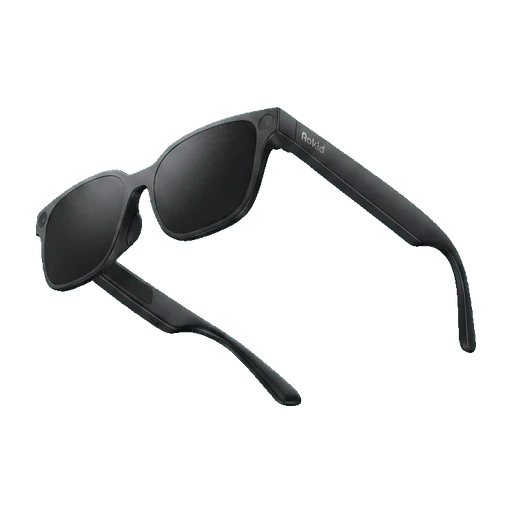
Consider these too
The nearest devices in the same class, ranked by availability and launch price — not by our opinion of them.
Specifications checked against the manufacturer's page on 2026-08-16. Manufacturer's specification
Product and company names used here are the trademarks of their respective owners and appear only to identify the hardware being compared. We are not affiliated with, sponsored by or endorsed by any of these manufacturers. Illustrations are our own.