Hearing conservation training is what OSHA requires under 29 CFR 1910.95 for any worker whose 8-hour noise exposure reaches an action level of 85 decibels, averaged as a time-weighted average (TWA). It has to happen before the worker is enrolled in the hearing conservation program and then at least once every 12 months after that, for as long as the exposure keeps them in it (OSHA, 29 CFR 1910.95).
The number that matters most is the gap between two thresholds. The permissible exposure limit — the level OSHA treats as an outright violation — is 90 dBA over 8 hours. The action level that triggers the whole conservation program is lower, 85 dBA. That 5 dB gap is deliberate: monitoring, testing and training are supposed to catch a problem while it is still preventable, not after the exposure has already crossed into violation territory.
What the action level actually triggers
Once monitoring shows a worker's exposure at or above 85 dBA TWA, OSHA requires the employer to run five things in parallel: noise monitoring accurate enough to identify who is exposed, audiometric testing at no cost to the worker, hearing protectors made available at no cost, annual training, and recordkeeping (OSHA Directive CPL 02-02-035). Hearing protection has to be available at the action level; it becomes mandatory to wear once exposure reaches the 90 dBA PEL, or immediately for any worker who has already had a standard threshold shift.
Audiometric testing and the standard threshold shift
Every worker in the program gets a baseline audiogram first — ideally before significant occupational noise exposure has already occurred — and then a new audiogram at least annually, compared against that baseline every time. A standard threshold shift (STS) is an average change of 10 dB or more at 2000, 3000 and 4000 Hz in either ear relative to the baseline. An STS does not automatically mean an injury has occurred, but it is the signal OSHA built the whole system around: it triggers a retest to confirm, a review of whether hearing protectors are being worn and fitted correctly, and, for confirmed shifts, referral for further evaluation. A physician or audiologist can also revise the baseline itself if a shift proves to be permanent.
What the annual training must cover
OSHA specifies the content, not just the frequency. Training has to explain how noise damages hearing, the purpose of hearing protectors along with instructions on selecting, fitting, using and caring for them, and the purpose of audiometric testing along with an explanation of the test procedures. It is required annually for every worker enrolled in the program — length of service on the job does not exempt anyone.
Recordkeeping
Noise exposure measurement records have to be kept for two years. Audiometric test records last considerably longer — for the duration of the affected employee's employment — because they are the only record that can show a hearing loss developed gradually across years on the same job.
How Poland and Germany compare
Neither country runs a program with the exact same name as OSHA's, but both regulate the same exposure with numbers close enough to compare directly.
| Requirement | United States (OSHA) | Poland | Germany |
|---|---|---|---|
| Action level | 85 dB(A), 8-hour TWA | 85 dB — highest permissible intensity (NDN) | 80 dB(A) lower action value; 85 dB(A) upper action value |
| Exposure limit | 90 dB(A), 8-hour TWA | 115 dB(A) max sound level; 135 dB(C) peak | 87 dB(A) exposure limit; 140 dB(C) peak |
| Hearing protection | Available at action level, mandatory at PEL | Mandatory once 85 dB is exceeded | Available at lower value (80 dB); mandatory use at upper value (85 dB) |
| Training | Annual, for every worker in the program | General BHP training cycle; no noise-specific annual rule | Before work starts and regularly after, once the lower action value is reached |
| Hearing testing | Baseline, then annual audiogram, employer-paid | Employer-funded periodic medical exams for noise-exposed roles | Occupational health monitoring offered per the instruction requirement |
Poland's threshold comes from the Ministry of Family, Labour and Social Policy's regulation on permissible workplace exposure limits, which sets 85 dB as the NDN (highest permissible intensity) for an 8-hour working day, with 115 dB and 135 dB as absolute ceilings on sound level and peak level respectively. Once measured exposure exceeds 85 dB, the employer must supply hearing protectors, work to reduce the noise at its source, and keep measurement records (PIP — Państwowa Inspekcja Pracy).
Germany's Lärm- und Vibrations-Arbeitsschutzverordnung (LärmVibrationsArbSchV) sets two action values instead of one: a lower value of 80 dB(A) or 135 dB(C) peak, which obliges the employer to run a risk assessment and make protectors available, and an upper value of 85 dB(A) or 137 dB(C) peak, at which point wearing them becomes mandatory. The exposure limit — 87 dB(A) or 140 dB(C) peak, factoring in the protection the hearing protectors actually provide — may never be exceeded. Instruction (Unterweisung) is required before work starts and regularly afterward once the lower action value is reached, covering the hazard, the measures in place, the exposure and action values themselves, the measurement results, and when workers become eligible for occupational health monitoring (§§ 6, 8, 11 LärmVibrationsArbSchV).
Where VR practice fits
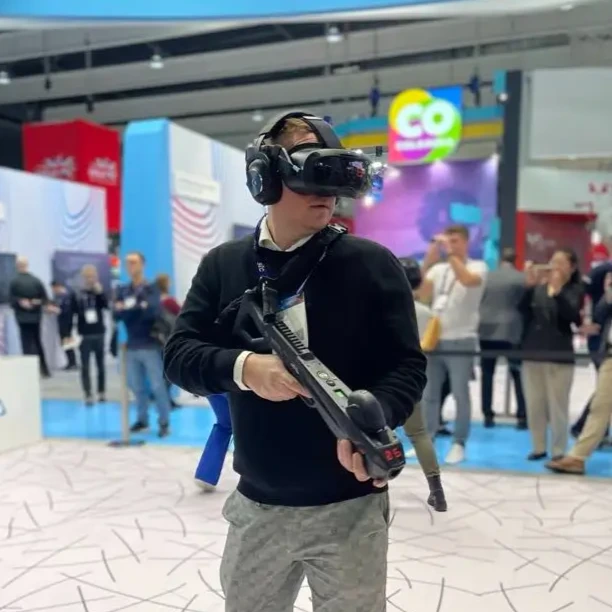
A hearing test happens in an audiology booth and no simulation replaces it — that part of the program stays exactly as it is. What training can do better is the part that happens on the floor: recognizing which zones and machines actually put a worker over the action level before the noise itself becomes the obvious symptom, and building the habit of putting hearing protection on before starting a task rather than after the ringing starts.
Our Workplace Hazard Spotting scenario puts trainees on a simulated production floor to practice exactly that kind of recognition — noise sources included — with a consequence for missing a hazard that a slide about decibel limits cannot create. The same logic behind why that rehearsal sticks is covered in why VR training is more effective than traditional training: repeated, consequence-carrying practice outperforms a one-time lecture, and noise-hazard recognition is a habit exactly like the machine-guarding checks covered in machine guarding training: what operators must know — both are about spotting a risk before it causes harm, not after.
Building a programme that holds up
Whichever country's numbers apply, three things carry the program: noise monitoring accurate enough to know who actually needs to be enrolled, audiometric testing on schedule with a real baseline to compare against, and training that explains why the test and the protectors matter — not just that they are required.
Browse the VR course catalog to see how hazard-recognition scenarios fit alongside a site's broader BHP training plan.