Respiratory protection training is the OSHA-mandated instruction under 29 CFR 1910.134 that teaches workers when a respirator is needed, how to put one on and check its seal, and how to use it correctly for the hazard in front of them. It applies to any workplace where engineering and administrative controls can't fully remove an airborne hazard — dust, fumes, vapors, or oxygen-deficient atmospheres — and OSHA is currently in the middle of a public rulemaking process that would change part of it, so it's worth being precise about what's actually changing and what isn't.
What the standard requires today
Before an employee can be fit tested or use a respirator on the job, the employer must provide a medical evaluation to confirm the person can physically tolerate wearing one (OSHA, 1910.134). Anyone using a tight-fitting respirator then needs a qualitative or quantitative fit test before first use, whenever the model changes, and at least once a year after that. Training has to happen before the first workplace use and be repeated annually, with retraining triggered early if the workplace or the respirator type changes enough to make the earlier session obsolete. Any workplace that requires respirators also needs a written respiratory protection program covering nine specific elements: selection procedures, medical evaluations, fit testing, proper use, cleaning and maintenance, air quality for supplied-air respirators, training on hazards and correct use, and a way to evaluate whether the program is actually working.
What OSHA is proposing to change
In a notice published July 1, 2025 (90 FR 28463), OSHA proposed removing the mandatory medical evaluation for two specific respirator types: filtering facepiece respirators — the disposable N95-style masks — and loose-fitting powered air-purifying respirators (OSHA, Deregulatory Rulemaking). Public hearings on the proposal ran virtually on August 19–20, 2026, as part of a broader package of more than twenty deregulatory rules OSHA is working through this year. Every other respirator class — tight-fitting elastomeric half- and full-face respirators, self-contained breathing apparatus, and everything else covered by 1910.134 — keeps its medical evaluation requirement unchanged.
The proposal does not touch fit testing, and it does not touch training. A law firm briefing on the hearing schedule is explicit that "the proposals are not yet final" and that employers "should continue to comply with existing OSHA standards unless and until OSHA issues final rules" (Sidley, Environmental, Health, and Safety Brief, 2026). In practice: if your program uses filtering facepiece or loose-fitting PAPR respirators, keep running medical evaluations exactly as you do now until a final rule says otherwise.
Why your training program doesn't change either way
Even in the version of the rule OSHA is proposing, nothing shortens the annual retraining cycle or removes the fit-test requirement. The medical evaluation answers a narrower question — can this specific person safely wear this specific respirator — and it's a fairly small piece of what a functioning respiratory protection program actually does day to day. The training is what determines whether a worker recognizes the situations that call for a respirator, selects the right one, dons it correctly, and knows when a filter needs replacing. None of that is under review. A program built around waiting for a final rule before investing in training has misread which part of the standard is actually in flux.
Respirator training rarely stands alone
In practice, the decision to reach for a respirator is usually made inside a bigger judgment call, not on its own. A worker checking a safety data sheet before opening a drum — the scenario we covered in hazard communication training — needs to know from the label and SDS whether the job calls for respiratory protection at all, and a worker entering a confined space needs to know it before the atmosphere is even tested. Treating respirator training as an isolated fifteen-minute module misses that it's really one link in a chain of hazard-recognition decisions, which is also why OSHA requires it to be refreshed whenever "the workplace or the type of respirator" changes — a new chemical process or a different confined space can trigger retraining on its own.
Building a program that survives an inspection
A respiratory protection program that holds up under a Państwowa Inspekcja Pracy, Gewerbeaufsichtsamt or OSHA inspection needs the written program on file, medical evaluation and fit-test records tied to named employees, and training records showing who was trained, on which respirator, and when the next annual session is due. Retraining triggers on three events specifically: a new respirator type enters the workplace, the hazard assessment changes, or an incident or near miss reveals that a worker didn't actually understand the earlier training. Since the proposal under review doesn't touch any of these obligations, the safest move for most employers is to keep the current process running rather than pause anything pending a final rule that could still be a year or more away.
What Poland and Germany require
Outside the US, the legal hook is different but the practical obligation is similar. Poland's Labor Code requires the employer to supply protective equipment free of charge and to inform the worker how to use it (Kodeks pracy, Art. 237(6) §1), on top of the general duty to provide safety training before work starts and periodically afterward. Germany's DGUV Regel 112-190 sets wear-time limits for respiratory equipment by type and recommends bringing in an occupational physician (Arbeitsmediziner) when those limits are set for a specific job (DGUV Regel 112-190, Chapter 8), sitting alongside the general instruction duty every employer carries under the Arbeitsschutzgesetz (ArbSchG § 12). Neither country ties respirator training to a medical-evaluation debate the way the current US proposal does — the training obligation stands on its own.
Why VR fits this training gap
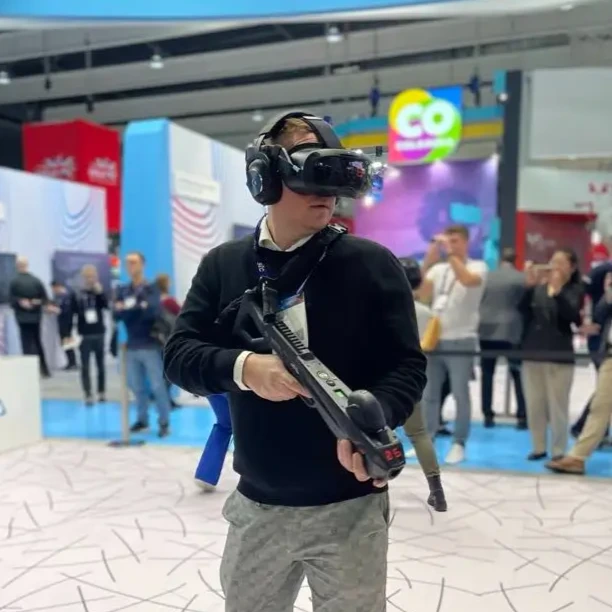
The part of respiratory protection training that actually fails in practice usually isn't the classroom session — it's a worker under time pressure not recognizing that a task now needs a respirator, or not checking the seal properly before walking into a hazard. Repeated, consequence-bearing practice closes that gap faster than a one-time presentation does (Science Direct, Safety Science, 2023; PwC, VR training study). Our Workplace Hazard Spotting scenario trains that recognition reflex directly, and our Confined Space Entry scenario — one of the classic settings where respirators are non-negotiable — puts the decision about atmospheric hazards and the right protective equipment in the trainee's hands before they ever face it for real; we covered the entry procedure itself in confined space entry training. Neither replaces the physical fit test or the medical evaluation a worker needs — VR builds the judgment call, not the equipment fitting.
Our course catalog lists the full set of scenarios if you're matching VR training to the specific hazards a site handles, on top of whatever respirator program is already running.