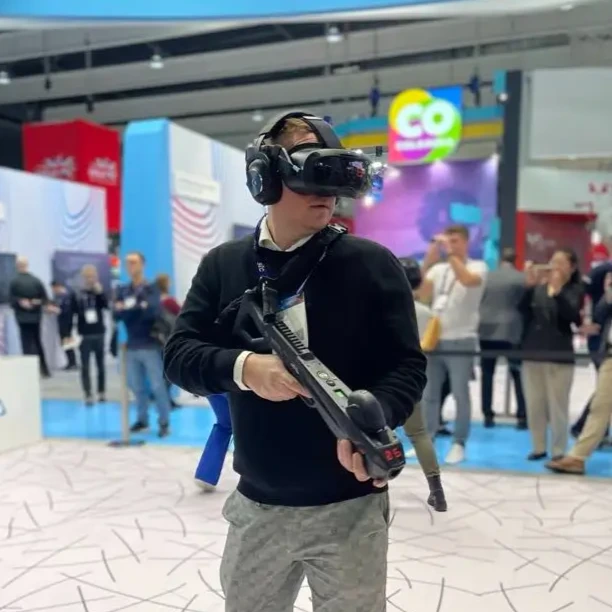
Fire extinguisher training teaches employees how to use a portable extinguisher on a small fire — and, just as importantly, when to walk away and evacuate. Both classroom sessions and VR simulations can deliver the required knowledge; the real difference is in the hands-on part, where VR lets people actually operate an extinguisher against a realistic fire without the cost, mess or risk of a live burn. This article compares the two formats against what regulators require and what the research shows.
The choice is not academic. In the United States, OSHA requires this training on hire and every year after, so whatever format you pick, you will repeat it for years across every new starter. A format that people find forgettable is a recurring cost; one that sticks is a recurring saving.
What fire extinguisher training must cover
At minimum, fire extinguisher training has to teach the general principles of extinguisher use and the hazards of fighting an early-stage fire. That is the legal floor in the US: OSHA 1910.157(g)(1) requires employers who make extinguishers available to familiarize workers with "the general principles of fire extinguisher use and the hazards involved with incipient stage fire fighting," and 1910.157(g)(2) sets the schedule as "upon initial employment and at least annually thereafter" (OSHA, 1910.157).
In practice, that translates into three things every course should deliver: the PASS technique, the judgement to know when a fire is too big to fight, and enough familiarity that a panicked person can still act. OSHA's own guidance spells PASS out — Pull the pin; Aim low at the base of the fire; Squeeze the handle; Sweep side to side — and adds a blunt caveat: "If you have the slightest doubt about your ability to fight a fire....EVACUATE IMMEDIATELY!" (OSHA eTool: Portable Fire Extinguishers).
The classroom approach: strong on theory, weak on the trigger
A classroom session is good at exactly what a lecture is good at: explaining fire classes, walking through PASS on slides, and discussing your site's specific hazards and evacuation routes. A skilled instructor can answer questions, correct misconceptions and read the room in a way no automated format matches.
Its weakness is the moment that actually matters — physically discharging an extinguisher under pressure. Pure classroom training often stops at "watching," and watching a video of PASS is not the same as doing it. Sites that want real practice usually bolt on a live-fire demo or a prop that burns propane, which brings its own costs: fuel, recharged extinguishers, outdoor space, weather dependence, cleanup and a safety officer. Those costs recur every single year, which is why many companies quietly skip the hands-on step and hope the theory is enough.
The VR approach: practice without the fire
VR fire extinguisher training puts the trainee in a realistic scene, hands them a virtual extinguisher, and starts a fire they have to put out with correct PASS technique — or fail and try again. The system can judge whether they aimed at the base, whether they swept correctly, and whether they should have evacuated instead of fighting a fire that was already too large.
The advantage is repeatable, safe practice. Nobody inhales a CO2 discharge, no extinguisher needs recharging, and a trainee can get it wrong five times and learn from every attempt — a practice loop a single live-fire demo cannot offer. It runs indoors, on a standard headset, in a 15-minute slot, and every attempt is recorded. Ready-made courses such as Fire Extinguisher Basic Training cover the standard scenarios out of the box, so there is no content to build.
Classroom vs VR, side by side
| Factor | Classroom (+ live-fire prop) | VR simulation |
|---|---|---|
| Hands-on practice | Only if a prop is added | Built in, every session |
| Repetition | Limited by fuel/props | Unlimited, instant reset |
| Recurring cost | Fuel, recharges, space, weather | Headset + course, no consumables |
| Safety / mess | Real fire, real discharge | Zero physical risk |
| Discussion & site-specific Q&A | Excellent | Limited |
| Completion records | Manual | Automatic |
| Weather / location | Often outdoors | Indoors, any room |
Neither column is "the loser." Classroom wins on discussion and local context; VR wins on realistic, repeatable, low-cost practice and on record-keeping.
What the research says about effectiveness
For the hands-on component, the evidence favors immersive practice. A 2024 peer-reviewed meta-analysis of 52 VR safety-training studies across 14 industries — fire safety among them — found VR beat traditional methods on both learning and retention, with the larger advantage in retention, the thing that matters months after a course (Scorgie et al., Safety Science 171, 2024). Separately, PwC measured VR learners completing training up to four times faster than in a classroom (PwC, 2020).
Be honest about the limits, though. The same meta-analysis flags high variation between studies, and a poorly built VR scenario can underperform a good instructor. VR also does not replace the discussion of your specific building, alarms and assembly points — which is precisely the classroom's strength. The evidence supports moving the practice into VR, not deleting the conversation.
A practical recommendation
For most workplaces, the strongest fire extinguisher training is a blend: a short briefing or e-learning module for fire classes, site hazards and evacuation rules, plus a VR session for the hands-on PASS practice that a slideshow cannot give. That combination hits the OSHA content requirement, gives people real muscle memory, and drops the yearly cost of live-fire props.
If a fire or another incident has already occurred, use the workplace accident cost calculator to separate absence, response, downtime, damage and other recorded costs before comparing prevention options.
Before you fix the schedule, check the required safety training for the job group — the tool shows how often the periodic course comes round and which provision sets that interval.
Whatever format you choose, keep completion records — OSHA's annual requirement is only demonstrable if you can show who trained and when. If you want to test the VR half before committing, a single headset and one course is enough to run a pilot group; browse the VR course catalog to match it to your hazards, see why VR training is more effective than traditional training for the full evidence base, and use the help center to connect a headset and track completions.